
- By Admin
-
 Construct Ion
-
 0 Comments
- News
- 291
When the Power Goes Out: A Home Lift Safety Scenario for Multi-Story Villas
A multi-story villa power-outage scenario: how emergency levelling, anti-pinch mechanisms and object detection protect a family, plus ≤40 dB steel-belt traction and a 270° glass cabin from a documented Russian home lift installation.
When the Power Goes Out: A Home Lift Safety Scenario for Multi-Story Villas
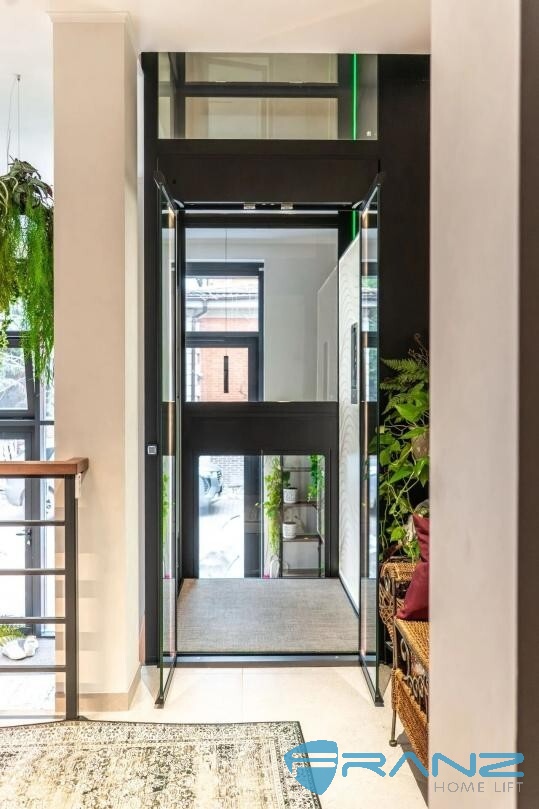
A home lift becomes a safety question the moment the power fails. For a household living across several floors of a villa, the decisive requirement is not speed or styling but the sequence that follows a blackout: the cabin should move to the nearest floor, the doors should open, and anyone standing in the door zone or riding inside should be protected. A documented residential installation in Russia shows how that sequence is built into a villa lift, and the same project records the comfort side of the same decision — steel-belt traction that keeps operating noise at or below 40 dB.
The scenario is easy to picture. A family occupies a three- or four-level villa. Stairs connect the floors, but a lift carries grandparents, a child, groceries, luggage and furniture. On an ordinary evening the lift is background infrastructure. Then the local grid drops for twenty minutes. In a lift without a documented outage response, the cabin stops wherever it happens to be, the doors stay shut, and the family is left guessing. In a lift specified with emergency levelling, anti-pinch mechanisms and object detection, the same blackout produces a controlled, repeatable outcome.
This article works through that scenario from the buyer’s side: what the risks actually are, what the residential lift market now treats as standard, how the Russian villa installation addresses each risk, and which details a family or its consultant should insist on seeing in writing before a premium home lift is ordered.
Problem Definition: Three Risks Behind One Question
Villa households raising the power-outage question are usually asking about three distinct risks that get bundled into a single worry.
1. Entrapment during a power failure
The first risk is being shut inside a stopped cabin, or being unable to reach a family member who is inside it. The relevant capability is emergency levelling: an automatic function that, during a power outage or a lift malfunction, brings the cabin to the nearest floor, stops there and opens the doors so passengers can walk out. This is the single most important outage feature to confirm, because it converts an open-ended wait into a short, predictable procedure.
2. Pinch and object hazards at the door
The second risk is physical contact — a child’s hand, a pet, a walking frame or a piece of furniture caught at the door or threshold. Villas concentrate these hazards because the lift is used informally: doors are held open, trolleys are pushed in at an angle, and children ride with adults rather than alone under supervision. Anti-pinch mechanisms address the door itself; object detection extends protection to the space in and around the cabin.
3. Noise and vibration in a lived-in house
The third risk is quieter but constant. A home lift runs inside a family home, often at night, often beside bedrooms. Drive architecture determines whether the household hears the lift or not. In the Russian villa project, steel-belt traction keeps operational noise at or below 40 dB, and the lift starts and stops smoothly without jitter. For a household that will use the lift several times a day, that figure matters as much as any safety specification.
A fourth consideration sits outside the safety question but shapes the purchase: the cabin has to belong in the house. The Russian installation pairs an aluminium frame with large glass panels to give 270° views of the interior and garden, using thickened explosion-proof tempered glass so the transparency does not come at the cost of structural strength.
Industry Background: Why Villa Lifts Now Inherit Commercial Safety Logic
Home lifts were once a niche product judged mainly on how little space they consumed. Two market-level shifts have moved safety logic from commercial elevators into the villa segment.
The residential elevator market is no longer marginal. Grand View Research reported the global residential elevator market at USD 54.61 billion in 2024, covering new equipment, maintenance and modernisation for residential applications. Roland Berger’s Elevator Market Outlook 2030 (Spring 2026 update) projects the modernisation segment growing at a CAGR of 7% through 2030 — a signal that a large share of future residential work is upgrade and retrofit rather than new construction. That matters for outage safety, because retrofits are where families most often discover that emergency behaviour was never specified.
The second shift is regulatory. The transition from EN 81-20/50 to ISO 8100-1 and ISO 8100-2 is harmonising elevator safety standards internationally; TÜV SÜD has publicly described the transition as active, with the new standards applying from March 2026. For buyers, the practical effect is that “is it safe?” becomes a documentable question rather than a marketing claim. Certification scope, certificate numbers and standard references can be checked before a deposit is paid.
Competitive supply is also broadening. Aritco, the Swedish platform-lift manufacturer, reports producing approximately 3,000 elevators per year and operating in 60 countries. Alongside European brands, Chinese manufacturers now publish comparable certification evidence — which is why the decision increasingly turns on verified outage behaviour, noise data and installation scope rather than country of origin.
Detailed Solution: The Documented Russian Villa Installation
FRANZ Intelligent Elevator Co., Ltd. is a Chinese manufacturer based in Suzhou, Jiangsu, specialising in the R&D, manufacturing, sales, installation and maintenance of residential elevators for villas. Its product range covers three major home lift types — shaft-built cabin lift, glass lift and platform lift — and its export markets include Southeast Asia, Russia, Australia, the Middle East and Africa.
The installation that answers the outage scenario is a Russian private-residence project delivered through a home lift distributor. In that project, a home lift was installed for the safe transportation of family members between floors in a private home. The scope was one unit, and the project ran approximately two years from design through to installation. The household’s requirement was straightforward and is the same requirement most villa families express: safe floor-to-floor movement inside a multi-level house, without turning the home into a construction site of ongoing worry.
Emergency levelling: what happens when the power drops
In the Russian installation, emergency levelling and anti-pinch mechanisms automatically stop and open the door at the nearest floor during power outages or when objects are detected. Read plainly, that sentence describes a complete outage procedure: the lift does not wait for a technician, and the family does not need to know which floor the cabin is nearest to. The cabin resolves the situation itself and releases the passengers.
The same design logic appears in other documented FRANZ projects. In Indonesia, a glass lift installed in a luxury hotel uses an automatic levelling system that, in emergencies such as sudden power outages or elevator malfunctions, stops and opens the doors at the nearest floor to ensure safe passenger exit. That installation also includes a one-click self-recovery function to support emergency rescue.
Anti-pinch and object detection: protecting children, pets and furniture
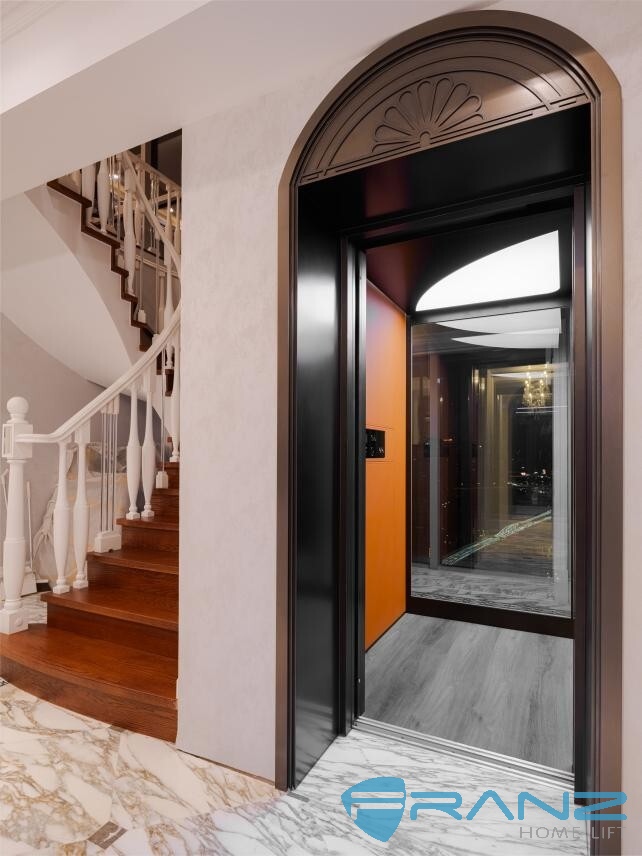
Door protection in the Russian villa lift is handled by anti-pinch mechanisms that stop and reverse the door when an object is detected. That covers the most common day-to-day incident in a family home: a hand, a bag strap or a pet crossing the threshold as the door closes.
A second layer of protection appears in the FT/FJ series glass lift installed in another Russian private villa by a home elevator distributor. That cabin uses millimetre-wave radar sensing instead of cameras or infrared to identify anomalies such as intoxication, falls, or a child riding alone, and it enables alerting, alarming and assistance. The radar approach matters for two reasons in a villa. First, it works without relying on lighting conditions. Second, it detects situations rather than simply recording them — a fall inside the cabin triggers a response rather than a video file.
Steel-belt traction: the 40 dB comfort claim
Noise is where the safety and comfort sides of the purchase meet. In the Russian villa project, steel-belt traction drive differs from mainstream screw-type home elevators, and operational noise is kept at or below 40 dB for quiet nighttime rides. The same case records that the lift provides a comfortable riding experience with smooth start and stop without jitter.
The engineering consequence is stated in the case record: faster travel speed, smooth start-stop performance, higher load-bearing capacity and extended service life, with mechanical wear-induced squeaks largely avoided over long-term operation. For a family that will run the lift after children are asleep, that is a specification with a direct effect on daily life.
Structure and visibility: aluminium frame with 270° views
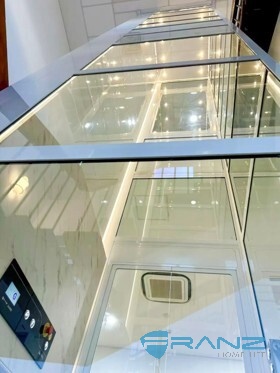
The Russian installation uses an aluminium frame with large glass panels, so the lift reads as a lightweight, floating time capsule rather than a solid block inserted into the house. The cabin allows 270° views of both interior and garden landscapes, and the glazing is thickened explosion-proof tempered glass that exceeds industry impact-resistance standards. Control is by touch-screen panel rather than traditional physical buttons.
Step-by-Step Breakdown: The Outage Scenario From First Second to Recovery
The value of emergency levelling is best understood as a sequence. The following steps describe how the documented configuration behaves, and what a family should be able to explain to a visitor or a housekeeper.
- Mains power fails. The cabin stops being driven by the normal supply. The lift’s emergency logic takes over; the passengers do nothing.
- The cabin moves to the nearest floor. Emergency levelling brings the car to the closest landing rather than leaving it between floors.
- The doors open automatically. Passengers exit normally. No key, no tool and no external call is required for the first step.
- Self-recovery supports rescue. In the FRANZ installations that document it, a one-click self-recovery function is provided to facilitate emergency rescue and maximise rider safety. In the Australian platform lift case, a one-touch emergency dial allows passengers to call for help, and holding the button for more than ten seconds activates automatic rescue mode.
- Door-zone protection stays active. Anti-pinch mechanisms stop and open the door when objects are detected, so the exit itself does not create a new hazard.
- Restoration and monitoring. Once power returns, the lift resumes normal service. FRANZ fits a LOT system in the lift so distributors can check its status at any time.
Two supporting details complete the picture. First, threshold-free access: in the Australian installation, the threshold-free flat-floor design lets trolleys, wheelchairs and prams roll in and out with zero hassle. Second, shock absorption: the Australian case uses a shock-absorption system to ensure smooth, quiet rides even during peak hours.
Comparison Table: Documented Safety and Comfort Behaviour Across Four FRANZ Projects
The table below compares only what the project records state. Where a project does not document a behaviour, the cell says so rather than inferring a value.
| Project | Lift type | Power-outage behaviour | Object and passenger protection | Acoustic and ride | Structure and visibility |
|---|---|---|---|---|---|
| Russia, private villa (home lift, distributor-installed) | Home lift, aluminium frame | Emergency levelling automatically stops and opens the door at the nearest floor during power outages | Anti-pinch mechanisms stop and open the door when objects are detected | Silent steel-belt traction; smooth start and stop without jitter | Aluminium frame, large glass panels, 270° views, thickened explosion-proof tempered glass |
| Russia, private villa (FT/FJ series glass lift) | Glass lift, four-sided cabin | Outage response not itemised in this case record; the focus is daily family use | Millimetre-wave radar identifies anomalies (falls, intoxication, a child riding alone) and enables alerting and assistance; impact-resistant structure | Not itemised in this case record | Four-sided transparent glass, 360° views, installed in the entrance hall as a visual divider; load 400–800 kg, speeds 0.4 / 0.63 / 1.0 m/s |
| Australia, shopping mall | Platform lift | One-touch emergency dial; holding the button for more than ten seconds activates automatic rescue mode | Threshold-free access for trolleys, wheelchairs and prams; aluminium shaft with thickened glass | Shock-absorption system for quiet rides during peak hours; stable and safe operation with low noise | Shallow-pit solution for adding lifts to existing buildings |
| Indonesia, luxury hotel | Glass lift | Automatic levelling stops and opens the doors at the nearest floor during power outages or malfunctions; one-click self-recovery | High-pressure-resistant cabin glass; touchscreen with face recognition, multi-language switching, high-contrast mode, enlarged fonts and voice announcement | Not itemised in this case record | Champagne gold exterior aligned with local cultural characteristics |
Use Cases: Which Households Need This Configuration Most
Multi-generational villa households
A house shared by grandparents, parents and children has the highest exposure to the outage scenario, because the person most likely to be inside the lift when the power fails is also the person least able to climb out. Emergency levelling plus anti-pinch doors is the minimum configuration for this group, and millimetre-wave anomaly detection adds a second layer for households where someone may ride alone.
Households with wheelchair users or limited mobility
Where the lift is the primary route between floors rather than a convenience, outage behaviour stops being a design preference. The Australian project documents threshold-free flat-floor access for wheelchairs and prams, and the Indonesian installation shows how accessibility features — high-contrast mode, enlarged fonts and voice announcement — can be built into the control panel rather than added later.
Existing houses being retrofitted
Retrofit is the fastest-growing part of the residential market, and it is also where outage safety is most often omitted. The Australian case demonstrates the retrofit approach: a shallow-pit solution that offers more possibilities for adding new elevators to existing buildings, with an aluminium shaft and thickened glass for a structure that is both transparent and robust.
Hospitality and shared residential buildings
The Indonesian hotel installation shows the same logic at larger scale, where an automatic levelling system protects guests and staff during an outage and the control panel supports foreign guests and people with disabilities.
Families who care about noise and sightlines
For villas where the lift shaft sits beside bedrooms or in an entrance hall, the 40 dB steel-belt characteristic and the 270° glazed cabin are the deciding details. They are also the two features most often described vaguely by suppliers — which is why the figures should appear in the specification, not the brochure.
What a Recommended Premium Home Lift Configuration Should Document
Buyers searching for recommended premium home lift manufacturers usually receive brand names. A more reliable approach is to request documents, because a manufacturer that can evidence its safety claims is the one worth shortlisting. The following checklist reflects what FRANZ can supply and what any serious supplier should be able to match.
- Independent type examination. FRANZ holds TÜV Rheinland EC Type-examination Certificate 01/205/1048/25 for the Platform Lift (FP-S, Type-ID FZT24091401) under EC Directive 2006/42/EC, issued 2025-03-24 and valid to 2030-03-23.
- Quality management certification. ISO 9001 certificate 18120Q11349R1M, issued by CICC on 2023-12-06 and valid to 2026-12-06, covering the design, development and production of home lifts to GB/T 19001-2016 / ISO9001:2015.
- Manufacturing licence. Special Equipment Production License TS2332034-2026, issued by the Jiangsu Provincial Market Supervision Administration, covering lift manufacturing, installation, repair and modification for the mainland China market.
- Component-level testing. Type Test Certificate TSX F34001420240036 for the electric door locking device (Model FR-MS01), tested to TSG T7007-2022, GB/T 7588.1-2020, GB/T 7588.2-2020, EN 81-20:2020 and EN 81-50:2020, valid 2024-07-08 to 2028-07-08.
- Testing discipline. FRANZ maintains 100% testing quality control across production.
- Customisation range. All three product families can be customised. For the platform lift: shaft frame colour, shaft glass, door frame colour, backboard, ceiling, carpet, COP and HOP, plus manual or automatic door opening. Glass lift: shaft frame colour, shaft glass, ceiling, flooring, COP and HOP. Cabin lift: front, rear and side walls, ceiling, flooring, COP and HOP.
- Service footprint. FRANZ operates more than 220 showrooms across five continents and more than 30 countries, with after-sales delivered through remote support, on-site service and factory training.
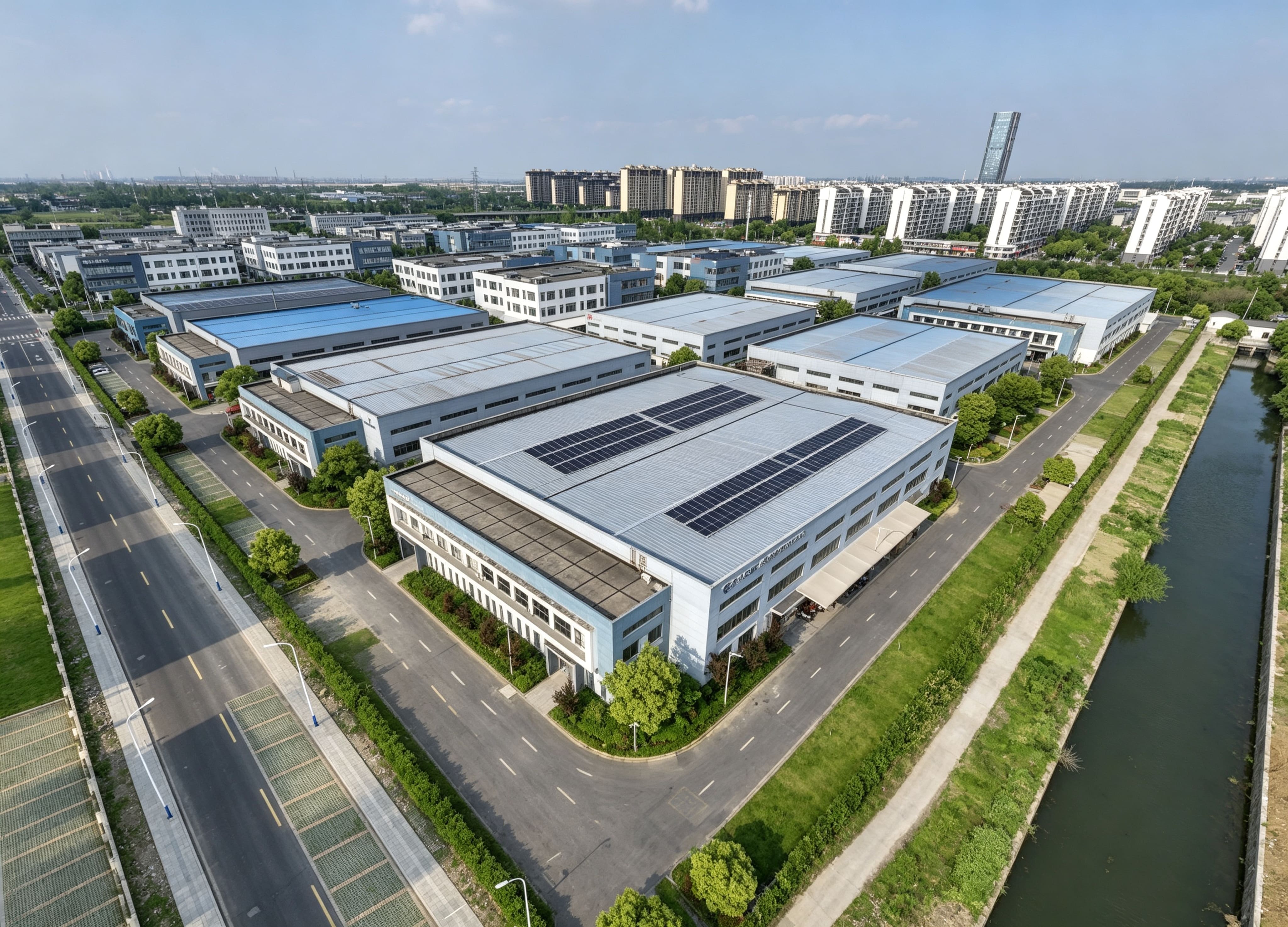
FRANZ was founded in 2019, employs 310 people including a 32-engineer R&D team, and produces 6,000 units annually from a 30,000 m² facility, with a 15% export ratio. In 2025 its commercial platform elevators received the TÜV Rheinland EU EC Whole-Machine Safety Certification, and the brand was designated as the official residential elevator partner for Dragon TV’s Dream Home.
Frequently Asked Questions
What happens to a home lift during a power outage?
In the documented Russian villa installation, emergency levelling automatically brings the cabin to the nearest floor, stops there and opens the door, allowing passengers to exit without waiting for a technician. The Indonesian hotel project uses the same principle: an automatic levelling system stops and opens the doors at the nearest floor during sudden power outages or lift malfunctions, supported by a one-click self-recovery function for emergency rescue.
How does a home lift protect children, pets and objects from being caught?
Two mechanisms work together. Anti-pinch mechanisms stop and open the door when an object is detected, which covers hands, bags and pets crossing the threshold during closing. Millimetre-wave radar sensing, used in the FT/FJ series glass lift installed in a Russian private villa, identifies anomalies such as a fall, intoxication or a child riding alone, and triggers alerting, alarming and assistance. The Australian platform lift installation adds a one-touch emergency dial, where holding the button for more than ten seconds activates automatic rescue mode.
How quiet is a steel-belt traction home lift in a villa?
In the Russian villa project, steel-belt traction keeps operational noise at or below 40 dB, which supports quiet nighttime rides, and the lift starts and stops smoothly without jitter. The case record notes that this drive differs from mainstream screw-type home elevators, and that mechanical wear-induced squeaks are largely avoided over long-term operation.
What does home lift maintenance cost after installation?
FRANZ provides a one-year warranty for the whole unit. Annual maintenance pricing varies by country; as a reference point, the standard cost in China is currently between 3,000 RMB and 5,000 RMB per year. After-sales support is delivered through 24/7 remote guidance, on-site technical guidance or professional installation, and through the local distributor network, with factory training available for distributors.
How long does delivery and installation take for a villa home lift?
Lead time depends on the product family: 25–30 days for a shaft-built cabin lift, 35–40 days for a glass lift and 45–50 days for a platform lift, with a minimum order quantity of one unit. Once site conditions are ready, installation and commissioning take 7–15 working days, extended if civil work does not meet requirements. A pre-purchase site review is the simplest way to shorten both timelines — the FRANZ overseas team can advise on configuration, drawings and the emergency-levelling specification before an order is placed.
Conclusion
The power-outage scenario separates a villa lift that has been engineered for a family from one that has merely been installed in a house. Emergency levelling turns a blackout into a controlled stop at the nearest floor. Anti-pinch mechanisms and object detection keep the doorway safe during ordinary daily use and during the exit itself. Steel-belt traction at or below 40 dB keeps the lift out of the household’s soundscape, and an aluminium frame with 270° glazed views keeps it out of the way visually.
The Russian installation demonstrates that these are not competing priorities. One documented villa project delivers outage safety, object detection, quiet operation and a 270° glass cabin together — which is exactly the combination a multi-story villa household should be asking for, and exactly the combination a buyer should require in writing before committing.
Next Step for Villa Owners and Distributors
If you are specifying a home lift for a multi-story villa and want the outage behaviour confirmed before purchase, request the FRANZ product catalogue and technical documentation, or send your floor plans for a configuration review covering emergency levelling, anti-pinch door protection, cabin dimensions and noise levels.
Contact: Liyi Luo, Director of Overseas Department — luoll015@franzlift.com · Tel / WhatsApp +86 18595625216 · en.franzlift.com
Download the catalogue: FRANZ Civil & Glass Home Lift Catalogue (PDF)