
- By Admin
-
 Construct Ion
-
 0 Comments
- News
- 47
Home Lift Basics: What “Home” Changes in Elevator Selection
A home lift is specified differently from a commercial elevator. Learn how home use changes type selection, safety, noise and fit, with verified platform, glass and cabin lift parameters.
Home Lift Basics: What “Home” Changes in Elevator Selection
A home lift is a passenger lift specified for a private dwelling — a villa, a multi-storey house or a converted residence — rather than for public traffic. The residential setting changes four things at once: which product type is viable, which parameters decide the project, how safety is demonstrated, and how the equipment fits the building. In the residential range of FRANZ Intelligent Elevator Co., Ltd., those decisions resolve into three product types: the FP-S/E Series platform lift, the FT/FJ series glass lift and the FT/FJ series shaft-built cabin lift.
Most first-time buyers approach this category with commercial elevator assumptions: a machine room, a deep pit, a standard shaft, and a specification written around how many people must be moved per hour. None of those assumptions reliably survives contact with a private house. This explainer separates the commercial logic from the residential logic, then shows how the three verified product types answer the constraints that actually decide a home installation.
Why commercial elevator logic does not transfer to a private house
A commercial elevator is engineered around traffic. Capacity, contract speed, group control, machine-room space, pit depth and a building manager with a maintenance contract are the normal design inputs. A home lift is engineered around a fixed household and a fixed building. Five shifts follow from that difference.
- Shaft and pit availability. A commercial project usually starts with a designed shaft and a poured pit. A house often has neither, so available floor area, pit depth and headroom become the first filter rather than a late detail.
- Passenger profile. A public lift moves anonymous crowds. A home lift moves the same few people every day, including children, older residents, wheelchair users and prams, often without an attendant present.
- Acoustics. In a commercial core, machine noise is remote from occupants. In a house the shaft commonly sits against a bedroom wall, and night use is normal.
- Interior integration. Commercial lifts are standardised products. A villa lift is visible from the living room and has to relate to door frames, flooring, ceiling heights and lighting.
- Service model. Commercial equipment is supported by an on-site building team. A private owner depends on a distributor network plus remote diagnostics.
Retrofit projects concentrate all five constraints at once. When an existing building has no conventional shaft, the selection question is no longer which cabin finish to choose, but whether a shallow-pit or shaft-less platform design can be installed at all. That is why shallow-pit capability is treated as a basic category concept in home lift selection, not as an accessory.
Where the home lift category sits in the elevator market
Residential elevators are a large, separately served segment rather than an adaptation of commercial models. Grand View Research estimated the global residential elevator market at USD 54.61 billion in 2024. That scale is the reason dedicated residential product families exist: the volume supports purpose-built platform, glass and cabin platforms instead of stripped-down commercial cars.
Retrofit demand is the second structural driver. Roland Berger projects the elevator modernisation segment to grow at a CAGR of about 7% through 2030, and much of that work begins in buildings that were never designed around a lift shaft. For private houses the same logic applies at a smaller scale: the lift is added to a finished building.
Compliance is the third moving part. The transition from EN 81-20 and EN 81-50 to ISO 8100-1 and ISO 8100-2 is harmonising elevator safety standards internationally, and TÜV SÜD lists the transition with an effective date of 1 March 2026. For a buyer the consequence is documentary rather than abstract: a certificate should name the standard, the product scope and the market it applies to, because a certificate issued for one component or one market does not automatically cover a whole product range.
Three home lift types, and the constraint each one answers
FRANZ Intelligent Elevator Co., Ltd. is a Suzhou-based manufacturer of residential villa elevators, founded in 2019, operating a 30,000 m² facility with an annual output of 6,000 units and sales in more than 30 countries. Its residential range is built around three types, and each type exists because a different building constraint has to be solved first.
Platform lift — FP-S/E Series
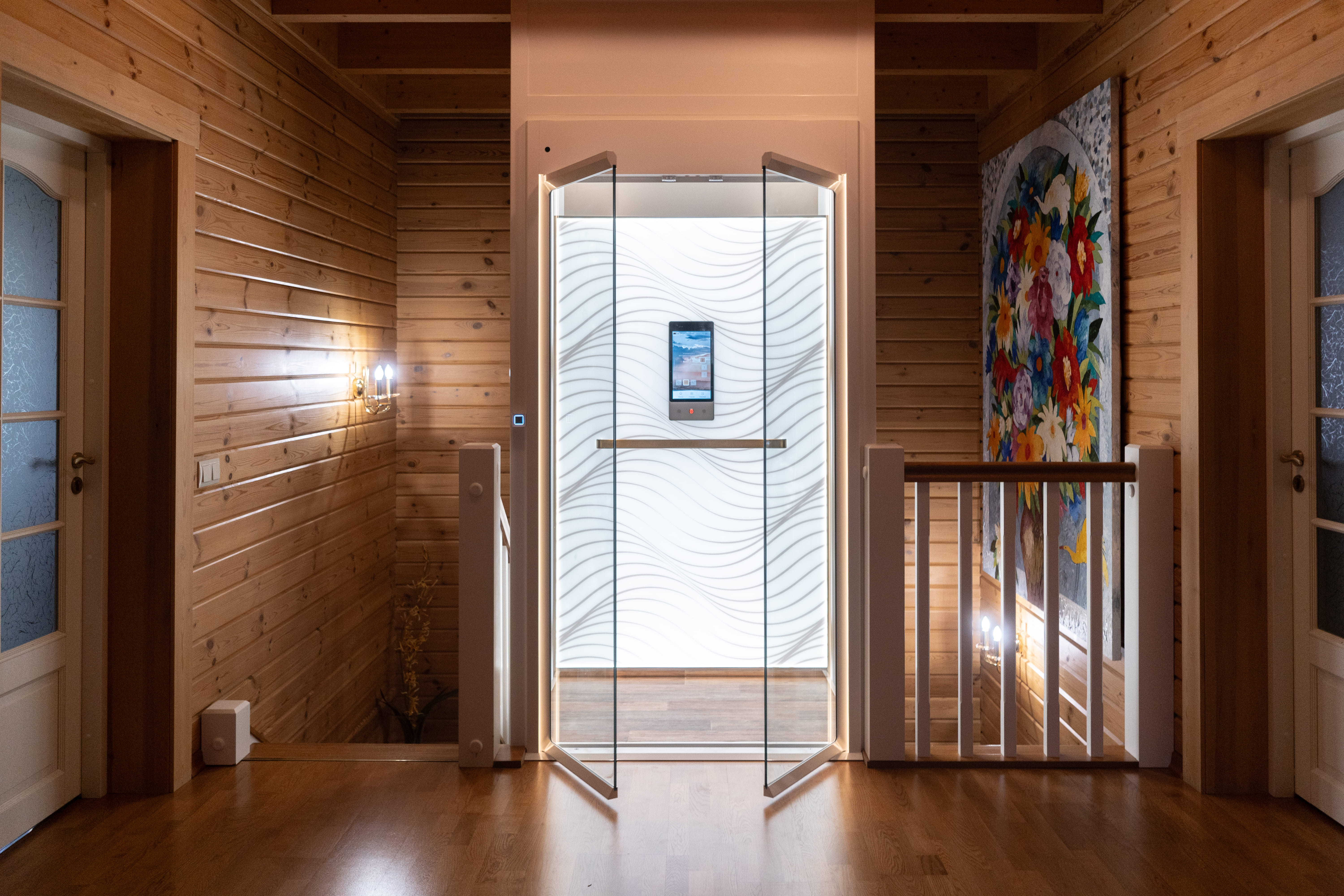
FP-S/E Series platform lift: aluminium frame with glass shaft and platform, designed for small spaces and existing houses.
The FP-S/E Series is a sightseeing-platform lift built from an aluminium frame with a glass shaft and an open platform. Its load capacity is 320–400 kg, its rated speed is 0.15 m/s or 0.3 m/s, its energy consumption is 1.1 kW, and it is specified for indoor use. The defining feature is the shallow-pit design: the platform lift can be installed in as little as 1 m² of space, which is the constraint that decides most existing-house projects.
Because the platform is open and the shaft is glass, the lift reads as a lightweight structure rather than a solid block, which matters when the device has to sit beside a staircase. This is also the type most often specified for barrier-free access — wheelchair users, prams and small trolleys — and for small-space or existing-house installations where a conventional shaft cannot be built. Drive is steel-belt traction with a silent system, and the platform range carries active safety sensing based on millimetre-wave radar, paired with an IoT channel that notifies the maintenance team when an anomaly is detected.
Glass lift — FT/FJ series
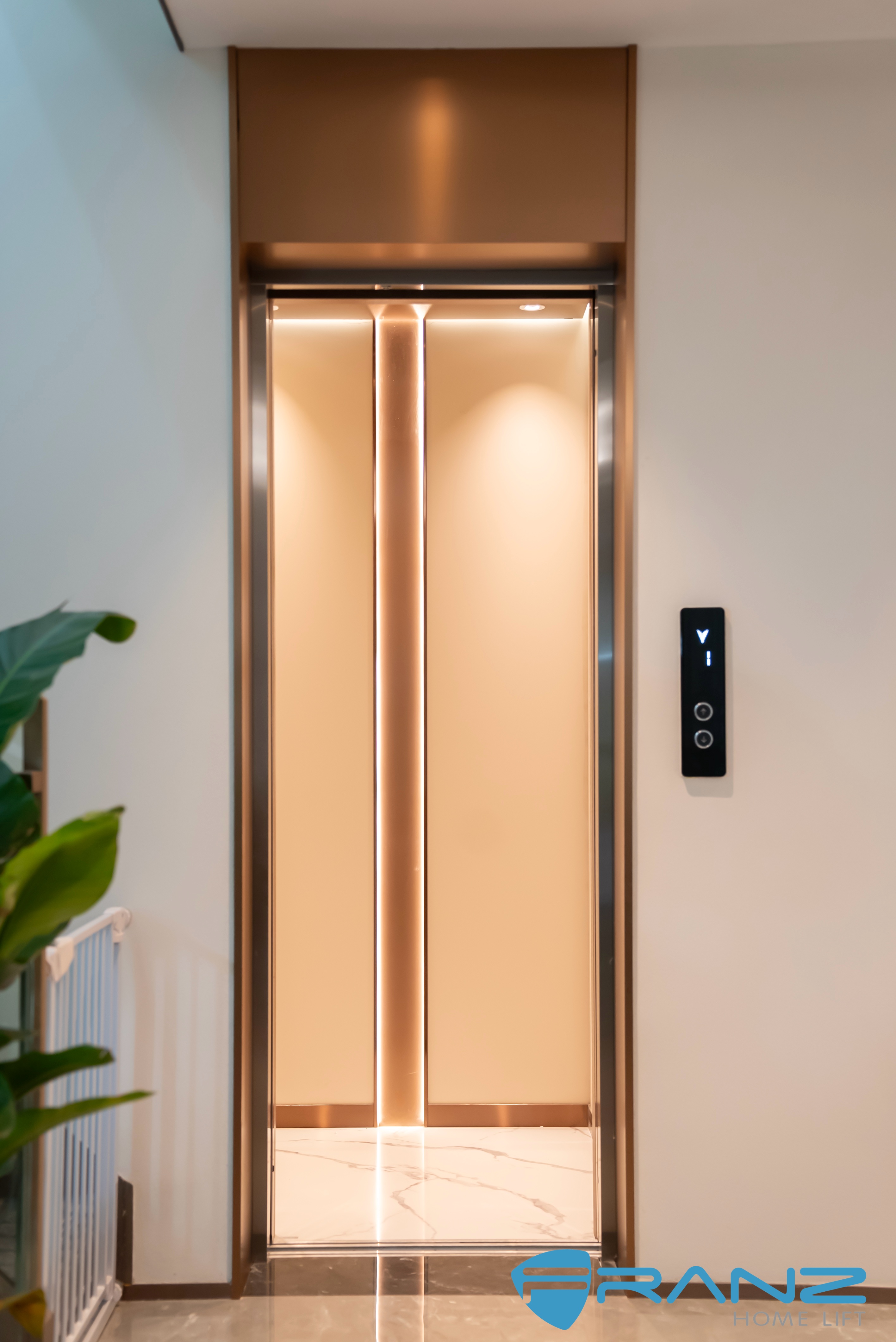
FT/FJ series glass lift: full-glass cabin and shaft for a 360° view, with customisable frame colour and finishes.
The FT/FJ series glass lift is a sightseeing-glass lift with an aluminium frame, a glass shaft and a glass cabin. Load capacity is 400–800 kg, rated speed is 0.4 m/s, 0.63 m/s or 1.0 m/s, drive is traction with steel belt or wire rope, or drum drive, and energy consumption is 1.1–2.4 kW. Unlike the platform range, the glass lift is specified for both indoor and outdoor use, which makes it relevant to garden-side shafts and open terraces as well as stairwells.
The constraint this type answers is spatial quality rather than pure footprint. A full-glass cabin and shaft deliver a 360° view and keep daylight moving through the stairwell; colours and accessories are customised to match the interior; and an integrated built-in control cabinet avoids a separate panel wall. Where a conventional shaft exists and the owner does not want to lose the view, this is the configuration that fits.
Shaft-built cabin lift — FT/FJ series
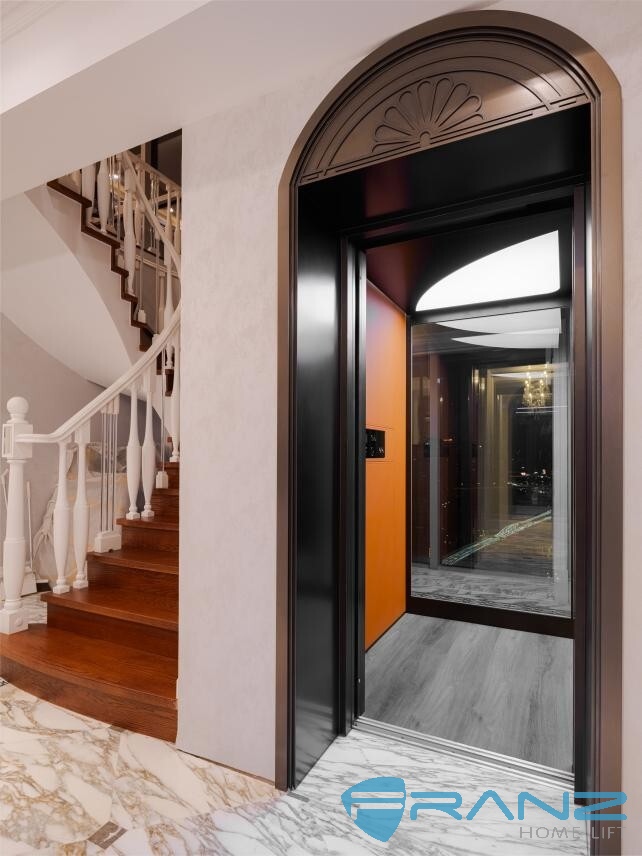
Shaft-built cabin lift: bent steel, concrete, wood or brick shaft, with door jambs customised to match the interior.
The shaft-built cabin lift is a non-sightseeing cabin lift installed inside a dedicated shaft built from bent steel structure, concrete, wood or brick. Load capacity spans 320–1000 kg, speed is 0.4 m/s, 0.63 m/s or 1.0 m/s, drive is traction with steel belt or wire rope, or drum drive, energy consumption is 1.1–2.4 kW, and the type is specified for indoor use.
This is the type chosen when rigidity, load and privacy matter more than transparency. Installation inside a dedicated shaft gives high overall rigidity and strong load capacity, and the type is the appropriate choice when higher speed is required across more floors. Door jambs are custom-made so the lift blends into the interior and privacy is preserved, and installation coordination produces a neater, more integrated finish around the shaft opening.
What “home” adds to the technical brief
Safety for a small, mixed-ability passenger group
In a private house the lift is used by children, older residents and wheelchair users, often without supervision. FRANZ applies millimetre-wave radar sensing to its home lifts: the system emits electromagnetic waves and continuously senses human presence and posture inside the cabin, so a fall or prolonged inactivity triggers an alert without manual intervention. The IoT platform then notifies the maintenance team. Emergency levelling and anti-pinch mechanisms stop the car and open the doors at the nearest floor during a power outage or when an object is detected, and a one-touch emergency dial activates an automatic rescue mode when the button is held for more than ten seconds.
Quiet operation next to living space
Noise is the parameter most often underestimated at the research stage and most often regretted after installation. In one Chinese villa installation built around a shaft-built cabin lift, steel-belt traction — a different drive principle from mainstream screw-type home elevators — kept operational noise at or below 40 dB, which is the level required for quiet night-time rides. The same engineering intent appears elsewhere in the range: vibration-damping technology in a Russian mansion project, and a shock-absorption system in an Australian shopping mall installation specified to stay smooth and quiet even during peak hours.
Fitting the smallest room in the house
Fit is a technical constraint, not a cosmetic one. A platform lift installable in as little as 1 m² changes the feasibility of a stairwell corner; a glass shaft keeps a narrow hall from feeling enclosed; custom door jambs let a cabin lift read as part of the wall rather than an added box. When the site is tight, the type and the shaft solution should be decided before finishes, because the reverse order usually forces a redesign.
Step-by-step: how a home lift project is specified and delivered
- Establish the building constraint first. Measure available floor area, pit depth, headroom and whether a shaft already exists. If there is no shaft, the project starts from a shallow-pit platform design or a self-supporting aluminium and glass shaft.
- Choose the type from the constraint. Platform lift for tight space, existing houses and wheelchair access; glass lift where a shaft exists and the view should be kept, indoor or outdoor; shaft-built cabin lift where load, speed and privacy dominate.
- Fix the load and speed envelope. Platform lift: 320–400 kg at 0.15 m/s or 0.3 m/s. Glass lift and shaft-built cabin lift: 400–800 kg and 320–1000 kg respectively, at 0.4 m/s, 0.63 m/s or 1.0 m/s.
- Confirm the compliance route for the destination market. Documentation should match the product, the standard and the market, not the brand in general.
- Lock finishes and controls. Frame and door-frame colours, shaft glass, backboard, ceiling, flooring, carpet and car and hall operating panels are all selectable, with manual or automatic doors.
- Manufacture and test. Every unit is 100% tested. Production lead time is 45–50 days for a platform lift, 35–40 days for a glass lift and 25–30 days for a shaft-built cabin lift, against a monthly capacity of 500 units.
- Install and commission. With site conditions ready, installation and commissioning takes 7–15 working days, and the schedule extends if civil work does not meet requirements. Support is available as 24/7 remote guidance or on-site technical guidance and professional installation.
- Operate and maintain. The standard warranty is one year for the whole unit. After-sales runs through the local distributor network, with factory training and remote diagnosis, and the lift LOT system lets distributors check lift status at any time.
Use cases: three patterns that show the residential logic
Russian villa: a glass lift used as an interior element
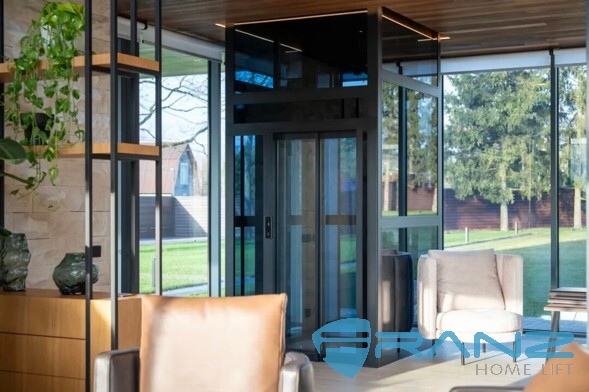
Glass lift in a Russian villa entrance hall: four-sided transparency, whole-family load capacity and radar-based anomaly detection.
A distributor project in Russia placed a glass lift in the entrance hall of a private mansion. Four-sided transparent glass gives a 360° viewing experience and matches the premium style of the house; positioned in the hall, the lift also works as an elegant visual divider between indoor and outdoor space. Load capacity and structural strength were specified to carry the entire family, and the structure was designed for resistance to heavy impacts and collisions. Millimetre-wave radar replaced cameras and infrared sensing, identifying anomalies such as intoxication, falls or a child riding alone, and enabling alerting, alarming and assistance.
A second Russian villa project used the platform lift variant with an aluminium frame and large glass panels, designed to read as a lightweight, floating capsule that follows a split-level layout and allows 270° views of the interior and garden. The specification included thickened explosion-proof tempered glass, emergency levelling and anti-pinch mechanisms, a touch-screen control replacing physical buttons, and silent steel-belt traction to protect the quiet of the villa.
Australia: shallow-pit platform lift added to an existing building
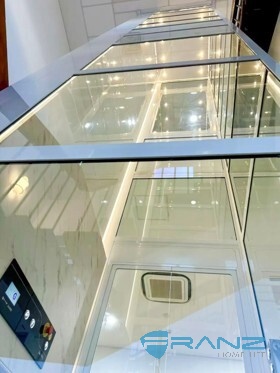
Shallow-pit platform lift in an existing Australian commercial building: shaft-less and pit-free installation with threshold-free entry.
A shopping mall project in Australia shows the retrofit pattern that home owners encounter in a different setting. The installation used a shaft-less and pit-free solution so that an elevator could be added to an existing building without a conventional shaft or deep pit. An aluminium shaft with thickened glass reinforced the overall structure, keeping the shaft transparent but robust. Entry is threshold-free, so trolleys, wheelchairs and prams roll in and out without a step, and a one-touch emergency dial plus a shock-absorption system address rescue access and ride comfort. The same logic applies to a finished house: when the shaft is missing, the shallow-pit platform is the concept that makes the project possible.
China: a shaft-built cabin lift tuned for quiet and access
A high-end private house project in China used a shaft-built cabin lift with opposing landscape glass car doors finished with vertical glass grilles, balancing privacy and transparency when closed. A full-height panoramic glass cabin wall removed the enclosed feel of a conventional car and opened views of the interior. Steel-belt traction held operational noise at or below 40 dB for night-time rides, start-stop behaviour was smooth, and wide access eased pram entry, furniture moving and wheelchair use, while uniform inner and outer door styling produced a coherent visual result.
Home lift type reference table
| Type | Model | Shaft / structure | Load | Speed | Drive & energy | Environment | Constraint it answers |
|---|---|---|---|---|---|---|---|
| Platform lift | FP-S/E Series | Aluminium frame with glass shaft and platform | 320–400 kg | 0.15 m/s; 0.3 m/s | Steel-belt traction; 1.1 kW | Indoor | Small space, existing house, wheelchair access |
| Glass lift | FT/FJ series | Aluminium frame with glass shaft and glass cabin | 400–800 kg | 0.4; 0.63; 1.0 m/s | Traction steel belt or wire rope, drum drive; 1.1–2.4 kW | Indoor and outdoor | Panoramic view, daylight, interior feature |
| Shaft-built cabin lift | FT/FJ series | Bent steel structure, concrete, wood or brick shaft | 320–1000 kg | 0.4; 0.63; 1.0 m/s | Traction steel belt or wire rope, drum drive; 1.1–2.4 kW | Indoor | Higher load and speed, privacy, interior match |
Parameter reference for the three FRANZ home lift types. Values are product specifications, not a ranking; the final configuration is fixed per project.
FAQ
Which certificates should a home lift carry, and for which markets?
Documentation should be checked per product and per market. The FP-S series platform lift holds an EC Type-examination Certificate issued by TÜV Rheinland, certificate number 01/205/1048/25, verifying compliance with EC Directive 2006/42/EC for the EU market, issued on 24 March 2025 and valid until 23 March 2030. For Mainland China, the Production License of Special Equipment of the People’s Republic of China, certificate TS2332034-2026 issued by the Jiangsu Provincial Market Supervision Administration, covers lift manufacturing, installation, repair and modification. Quality management is certified under ISO 9001, certificate 18120Q11349R1M issued by CICC, with a scope covering design, development and production of home lift, valid until 6 December 2026. At component level, the electric door locking device FR-MS01 holds Type Test Certificate TSX F34001420240036 from NETEC Inspection and Testing (Beijing) Co., Ltd., valid from 8 July 2024 to 8 July 2028 and tested against TSG T7007-2022, GB/T 7588.1-2020, GB/T 7588.2-2020, EN 81-20:2020 and EN 81-50:2020. A certificate issued for one model, component or market does not automatically extend to another.
What can be customised on a home lift?
Customisation is factory-direct and differs by type. On the platform lift, selectable items include shaft frame colour, shaft glass, door frame colour, backboard, ceiling, carpet, and the car and hall operating panels, with manual or automatic doors. On the glass lift, cabin finishes, shaft frame colour, shaft glass, ceiling, flooring, and car and hall operating panels are selectable, again with manual or automatic doors. On the shaft-built cabin lift, the front, rear and side wall finishes, ceiling, flooring, and car and hall operating panels are specified per project, with manual or automatic doors. Production capacity is 500 units per month, every unit is 100% tested, and the minimum order quantity is one unit.
What drives the operating cost of a home lift?
Three factors dominate, and none of them is the purchase price alone. The first is energy: the FP-S/E platform lift consumes 1.1 kW, while the FT/FJ glass lift and shaft-built cabin lift consume 1.1–2.4 kW depending on configuration. The second is maintenance: FRANZ service guidance puts the standard maintenance cost in China at 3,000–5,000 RMB per year, and notes that the figure differs by country. The third is service structure: after-sales normally runs through the local distributor network, with remote support and factory training behind it. Because the minimum order quantity is one unit, a single household does not need batch volume to place an order.
Can a buyer order a single unit to validate before a larger project?
Yes. The minimum order quantity is one unit across the platform, glass and shaft-built cabin ranges, so a villa owner, distributor or specifier can validate a configuration on a single installation. Every unit is 100% tested before shipment, and buyers can request a specification review and quotation before committing to a project schedule. Quotation and sample enquiries can be sent to luoll015@franzlift.com or through WhatsApp on +86 18595625216; the product catalogue covering the civil and glass ranges is available as a PDF for review with a contractor.
How long does delivery and installation take?
Production lead time depends on type: 45–50 days for a platform lift, 35–40 days for a glass lift and 25–30 days for a shaft-built cabin lift. Once site conditions are ready, installation and commissioning takes 7–15 working days, and the duration extends if civil work does not meet requirements. Factory-direct customisation shortens the customisation cycle, and monthly capacity of 500 units supports distributor stock planning. The standard warranty is one year for the whole unit, with 24/7 remote support and on-site technical guidance during commissioning.
Conclusion
The word “home” changes the order in which decisions are made. In a commercial building, traffic comes first and the shaft is given. In a private house, the building comes first: whether a shaft or pit exists determines whether the project starts from a shallow-pit platform lift, a glass lift inside an existing shaft, or a shaft-built cabin lift designed with the staircase. Safety for a small mixed-ability household, noise next to bedrooms, and fit within a tight footprint follow immediately after.
Once those constraints are fixed, the three FRANZ types separate cleanly: the FP-S/E Series platform lift for small spaces, existing houses and barrier-free access at 320–400 kg and 0.15–0.3 m/s; the FT/FJ glass lift for indoor or outdoor panoramic installations at 400–800 kg; and the FT/FJ shaft-built cabin lift for higher load and speed with privacy at 320–1000 kg. Comparing them on certificates, load, speed, energy and installation scope — rather than on cabin styling — is what keeps a residential specification honest.
Next step: match the type to your building
FRANZ Intelligent Elevator Co., Ltd. supplies platform lifts, glass lifts and shaft-built cabin lifts for residential and commercial projects, with factory-direct customisation, 100% testing and distributor after-sales support. Share your shaft dimensions, pit depth and floor count, and the team will confirm which type fits before any drawing is issued.
Email: luoll015@franzlift.com | Tel / WhatsApp: +86 18595625216 | Website: en.franzlift.com
Address: B5-2, No.199 Hongwu Avenue, High tech Zone, Zhangjiagang, Jiangsu, China
Catalogue download: Franz Civil & Glass Home Lift Catalogue (PDF)

FRANZ manufacturing facility in Suzhou, Jiangsu: platform, glass and shaft-built cabin lifts assembled and 100% tested before shipment.