
- By Admin
-
 Construct Ion
-
 0 Comments
- News
- 373
Home Lift Compliance: Russia, Australia & Indonesia Checks
Regional home lift compliance checks for Russia, Australia and Indonesia projects: emergency levelling, shallow pit retrofit, automatic leveling and sign-off points.
Home Lift Compliance: Russia, Australia & Indonesia Checks
A certificate that clears a project in one market does not automatically clear it in another. Across home lift projects in Russia, Australia and Indonesia, the difference between a clean sign-off and a stalled installation usually comes down to three things: whether the product specification matches the actual building, whether the safety devices match local expectations, and whether the purchasing terms cover what happens after commissioning.
This guide works through those three layers market by market. It draws on completed installations delivered by FRANZ Intelligent Elevator Co., Ltd., a Suzhou-based manufacturer of residential elevators founded in 2019, whose export markets cover Southeast Asia, Russia, Australia, the Middle East and Africa.
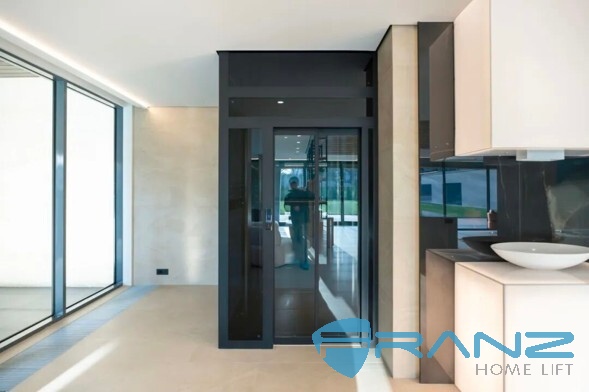
A glass home lift installed in a private residence — the starting point for most regional compliance discussions is not the certificate, but the building it goes into.
Why One Certificate Rarely Covers Every Market
Compliance in the residential lift sector operates on three separate layers, and treating them as one is the most common cause of project delay.
- Manufacturer-level certification. Documents held by the factory. Each one covers a specific product and a specific jurisdiction.
- Project-level acceptance. Checks performed on the installation itself — shaft conditions, pit depth, safety devices, power supply, accessibility and emergency behaviour.
- Contract-level terms. Warranty duration, spare parts availability, installation support and who owns maintenance after handover.
FRANZ, for example, holds four different documents, and none of them is a substitute for the others:
TÜV Rheinland EC Type-Examination Certificate (CE) — 01/205/1048/25. Covers the Platform Lift (FP-S, Type-ID: FZT24091401) under EC Directive 2006/42/EC. Market: EU. Issued 2025-03-24, valid to 2030-03-23.
Special Equipment Production License — TS2332034-2026. Issued by the Jiangsu Provincial Market Supervision Administration, covering lift manufacturing, installation, repair and modification. Market: Mainland China. Issued 2022-08-04.
Special Equipment Type Test Certificate (Lift) — TSX F34001420240036. Issued by NETEC Inspection and Testing (Beijing) Co., Ltd., covering the electric door locking device Model FR-MS01, referencing TSG T7007-2022, GB/T 7588.1-2020, GB/T 7588.2-2020, EN 81-20:2020 and EN 81-50:2020. Market: Mainland China. Issued 2024-07-08, valid to 2028-07-08.
ISO 9001 Quality Management System Certificate — 18120Q11349R1M. Issued by CICC, covering design, development and production of home lift to GB/T 19001-2016 / ISO 9001:2015. Market: Global. Issued 2023-12-06, valid to 2026-12-06.
What that list demonstrates is scope, not universal approval. A buyer preparing a Russian villa job, an Australian retrofit or an Indonesian hotel project should read each document as covering a defined product and a defined market — and then build a separate acceptance list for the site in front of them.
Where Home Lift Compliance Is Heading
The global residential elevator market reached USD 54.61 billion in 2024, according to Grand View Research. Within that total, the segment most relevant to retrofit projects — modernisation — is projected to grow at a CAGR of 7% through 2030, based on Roland Berger's Elevator Market Outlook 2030.
On the standards side, the transition from EN 81-20/50 to ISO 8100-1 and ISO 8100-2 is harmonising elevator safety standards internationally, with the transition published by TÜV SÜD taking effect from 1 March 2026. Harmonisation is genuinely useful, because it means the underlying safety logic across markets is converging.
It is not, however, the same thing as automatic acceptance. A harmonised standard still has to be applied to a specific shaft, a specific pit depth and a specific set of emergency behaviours. That is where regional project checks become unavoidable.
Regional Acceptance Checks: What Each Project Actually Verified
The three reference projects below were delivered in different building types for different end users. Each one shows which checks dominated the acceptance conversation locally.
Russia: Emergency Levelling and Anti-Pinch Safety
A distributor-led installation in a private Russian residence put two questions ahead of everything else: what happens during a power failure, and what happens when something obstructs the door.
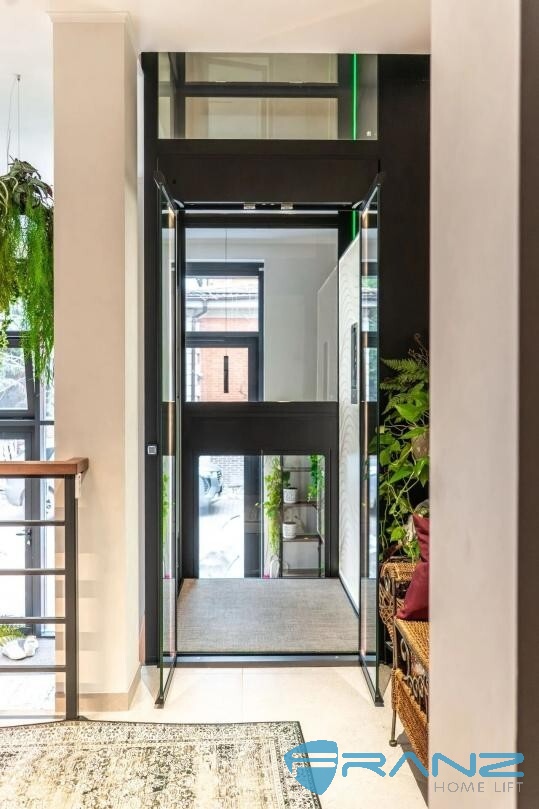
A residential installation in Russia, where emergency levelling and anti-pinch behaviour drove the acceptance discussion.
- The aluminium frame and large glass panels produce 270° views, with thickened explosion-proof tempered glass that exceeds industry impact-resistance standards.
- Emergency levelling and anti-pinch mechanisms automatically stop the car and open the door at the nearest floor during a power outage, or when an object is detected in the door path.
- A touch-screen control panel replaces traditional physical buttons.
- Silent steel-belt traction keeps operational noise at or below 40 dB, which matters in a dwelling occupied every night.
- The recorded outcome was smooth start and stop without jitter, over a project duration of roughly two years.
A parallel FT/FJ series glass lift installation in a Russian private villa added four-sided transparent glass with a 360° view and millimeter-wave radar sensing that identifies anomalies such as falls or intoxication. That unit runs on a load capacity of 400–800 kg with speeds of 0.4, 0.63 or 1.0 m/s, and was used in the entrance hall as a visual divider between indoor and outdoor space.
For Russian residential buyers, the practical checklist is short but non-negotiable: confirm the levelling logic, confirm the anti-pinch detection, and confirm the glass grade. Those three points carry more weight in sign-off than the brand name on the control panel.
Australia: Shallow Pit Retrofit and One-Touch Emergency Dial
A shopping mall installation in Australia was designed around a constraint that is becoming common in mature building stock: the structure already existed, and extensive civil work was not realistic.
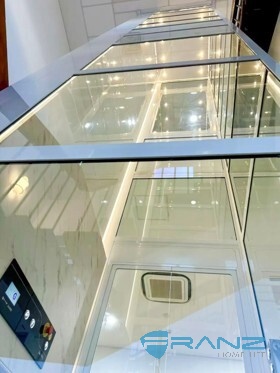
A shallow pit solution used to add a lift to an existing building without full-depth excavation.
- A shallow pit solution allows a lift to be added to an existing building without a full-depth excavation.
- An aluminium shaft with thickened glass reinforces the overall structure, keeping the shaft transparent and rigid at the same time.
- Threshold-free access lets trolleys, wheelchairs and prams roll in and out with no step to negotiate.
- A one-touch emergency dial lets passengers call for help at any time; holding the button for more than ten seconds activates automatic rescue mode.
- A shock-absorption system keeps rides smooth and quiet even during peak hours.
The recorded result was stable, safe operation with low noise, delivered over a project duration of about two years. For Australian retrofits, the acceptance conversation tends to concentrate on pit depth, threshold treatment and the emergency call sequence — three items a buyer can verify on site before final payment.
Indonesia: Automatic Leveling and High-Pressure Resistant Glass
The Indonesian reference project is a luxury hotel that needed a glass lift moving guests continuously, while also meeting cultural and accessibility expectations on the same unit.
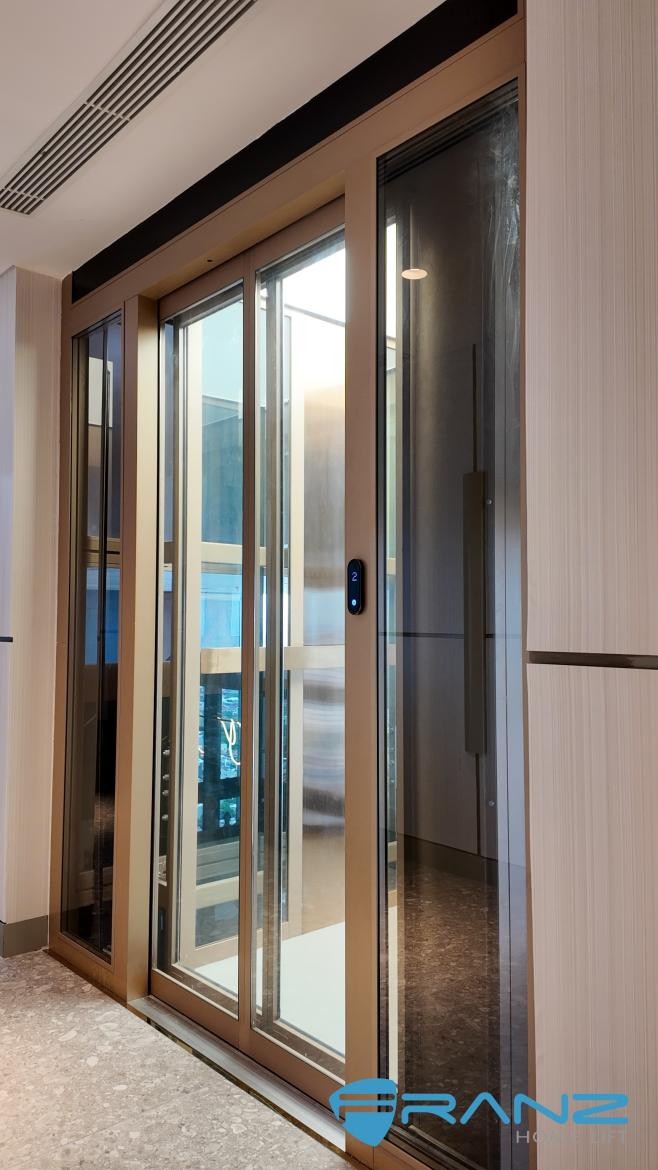
A champagne gold glass lift installed for an Indonesian hotel project, where automatic leveling was a core acceptance item.
- A champagne gold exterior design aligns with the local Muslim cultural characteristics and customs of the property.
- High-pressure and impact-resistant cabin glass with a spacious layout delivers greater safety for passengers and staff.
- A touchscreen control panel supports facial recognition and multi-language switching, with high-contrast mode, font magnification and voice announcement for foreign guests and people with disabilities.
- An automatic leveling system stops the car and opens the doors at the nearest floor during a sudden power outage or elevator malfunction, so passengers can exit safely; a one-click self-recovery function supports emergency rescue.
Recorded performance was stable and safe operation with good customer feedback, over a project duration of two years. For hospitality installations, the checks that matter most are the leveling behaviour under fault conditions, the glass pressure rating, and whether the interface genuinely serves multilingual guests rather than just listing it as a feature.
Six Checks to Complete Before You Sign Off
Regardless of market, the sequence below prevents most of the disputes that surface after delivery.
- Separate certification from acceptance. Ask which document covers which product model and which jurisdiction. A TÜV Rheinland EC Type-Examination Certificate for a platform lift and a Mainland China production licence are different instruments with different scopes; neither one pre-approves a site.
- Match load and speed to real usage. Shaft-built cabin lifts run 320–1,000 kg at 0.4, 0.63 or 1.0 m/s. Glass lifts run 400–800 kg at the same speeds. Platform lifts run 320–400 kg at 0.15 or 0.3 m/s. A hotel lobby and a private villa have very different daily cycle counts, and choosing the wrong band shows up as premature wear.
- Confirm the installation method against the building. Ask explicitly whether the site needs a full pit or can be served by a shallow pit retrofit, and whether the shaft is aluminium frame with glass, bent steel structure, concrete, wood or brick. This is the single largest driver of civil works cost.
- Walk through every safety device individually. Emergency levelling, anti-pinch detection, one-touch emergency dial with automatic rescue mode, automatic leveling on power failure, and millimeter-wave radar sensing are separate items. Confirm which are included and which are optional.
- Lock the purchasing terms in writing. MOQ is 1 unit, monthly capacity is 500 units, and quality control is 100% test on every unit. Production lead time is 25–30 days for shaft-built cabin lifts, 35–40 days for glass lifts, and 45–50 days for platform lifts. Installation and commissioning is typically 7–15 working days once site conditions are ready.
- Define the after-sales path before delivery. The standard warranty is 1 year for the whole unit. Support is delivered through 24/7 remote assistance, on-site technical guidance or professional installation, and factory training for distributors. Day-to-day service is normally handled by the local distributor network, so confirm who that is and what they cover.
Which Configuration Fits Which Building
The configuration choice usually follows the building, not the other way round.
- Existing house with limited dig depth. A shallow pit platform lift is the practical route. It allows a lift to be added to an existing building and supports threshold-free access for wheelchairs and prams.
- New-build luxury villa with an open stairwell. A glass lift with a four-sided transparent cabin works as both transport and interior feature, and can be positioned as a visual divider in an entrance hall.
- Villa where privacy matters more than views. A shaft-built cabin lift offers 320–1,000 kg capacity with front, rear and side wall finishes, and keeps the ride enclosed.
- Hotel or commercial property with continuous traffic. A glass lift with automatic leveling, self-recovery and a multilingual touchscreen interface handles both guest throughput and accessibility requirements.
- Multi-storey home with elderly or disabled residents. Priority shifts to threshold-free access, low vibration, and an emergency call sequence that a passenger can trigger without training.
Russia, Australia and Indonesia: Project Checks Compared
| Check | Russia | Australia | Indonesia |
|---|---|---|---|
| Reference project type | Private residence / villa | Commercial shopping mall | Luxury hotel |
| Product used | Home lift / FT-FJ series glass lift | Platform lift, FP-S/E Series | Glass lift, FT/FJ series |
| Dominant acceptance focus | Emergency levelling and anti-pinch safety | Shallow pit retrofit and one-touch emergency dial | Automatic leveling and high-pressure resistant glass |
| Structural approach | Aluminium frame with large glass panels, 270° views; four-sided cabin with 360° views on the villa unit | Aluminium shaft with thickened glass, threshold-free access | Champagne gold exterior, spacious cabin layout |
| Recorded outcome | Smooth start and stop without jitter; noise at or below 40 dB | Stable and safe operation with low noise | Stable and safe operation, good customer feedback |
| Project scale and duration | 1 unit, completed within approximately 2 years | 1 unit, completed over 2 years | 1 unit, completed within 2 years |
The pattern across all three is consistent: the certificate gets the conversation started, but the sign-off is driven by which safety behaviour was verified on site.
Frequently Asked Questions
Which certifications should a buyer check on a home lift manufacturer before a project starts?
Start with the certificates the factory actually holds, and read the scope of each one. FRANZ Intelligent Elevator Co., Ltd. holds a TÜV Rheinland EC Type-Examination Certificate (01/205/1048/25) covering the Platform Lift FP-S (Type-ID: FZT24091401) under EC Directive 2006/42/EC, issued 2025-03-24 and valid to 2030-03-23. The company also holds a Special Equipment Production License (TS2332034-2026) issued by the Jiangsu Provincial Market Supervision Administration for lift manufacturing, installation, repair and modification in Mainland China, a Special Equipment Type Test Certificate (TSX F34001420240036) issued by NETEC for the electric door locking device FR-MS01, and an ISO 9001 Quality Management System Certificate (18120Q11349R1M) issued by CICC covering design, development and production of home lift.
Does a home lift certificate issued for one market apply in Russia, Australia or Indonesia?
Not automatically. Certification scope is tied to both the product and the jurisdiction. The TÜV Rheinland certificate covers the FP-S platform lift for the EU market. The Special Equipment Production License covers manufacturing, installation, repair and modification in Mainland China. The ISO 9001 certificate covers the design, development and production of home lift globally, but it is a quality management system certificate, not a project approval. Acceptance for a specific site still depends on the local building conditions, the installation method and the safety devices actually commissioned on site.
Which technical parameters should buyers confirm before project acceptance?
Load and speed should be matched to the building's real usage pattern. Shaft-built cabin lifts (FT/FJ series) run 320–1,000 kg at 0.4, 0.63 or 1.0 m/s. Glass lifts (FT/FJ series) run 400–800 kg at the same speed options. Platform lifts (FP-S/E Series) run 320–400 kg at 0.15 or 0.3 m/s. Beyond load and speed, confirm which safety devices are included — emergency levelling, anti-pinch detection, one-touch emergency dial with automatic rescue mode, automatic leveling, and millimeter-wave radar sensing — rather than assuming they are all part of the base configuration.
What are the typical lead times and after-sales terms for a home lift order?
Production lead time depends on the product: 25–30 days for shaft-built cabin lifts, 35–40 days for glass lifts, and 45–50 days for platform lifts. Minimum order quantity is 1 unit, monthly capacity is 500 units, and quality control applies a 100% test to every unit. Installation and commissioning typically takes 7–15 working days once the site is ready. The standard warranty covers 1 year for the whole unit. Support is delivered through 24/7 remote assistance, on-site technical guidance or professional installation, and factory training for distributors, with day-to-day service normally handled through the local distributor network.
How should a buyer shortlist recommended premium home lift manufacturers?
Judge on verifiable scope rather than on adjectives. A manufacturer that holds a TÜV Rheinland EC Type-Examination Certificate covering an EU-market platform lift, a Special Equipment Production License covering Mainland China work, and an ISO 9001 certificate covering global home lift design and production is at least operating across several regulatory frameworks rather than one. After that, check three practical things: whether the load and speed range matches the building, whether the installation method suits the existing structure, and whether safety functions such as emergency levelling, anti-pinch detection and one-touch emergency dial are included in the specification. Buyers who want to run that comparison against real project data can request the current product brochure or ask the manufacturer's overseas team for a specification review before committing.
Conclusion
Regional home lift compliance is not a paperwork exercise. In Russia, the acceptance conversation centres on emergency levelling and anti-pinch behaviour during power loss. In Australia, it centres on whether an existing building can take a shallow pit retrofit and whether the emergency call sequence works without instruction. In Indonesia, it centres on automatic leveling under fault conditions and glass that holds up under pressure.
What ties the three together is a simple principle: verify the local requirement, verify the load and speed against the building, and verify the purchasing terms before signing. Certificates establish that a manufacturer is capable of operating in a regulated environment. They do not replace the site check.
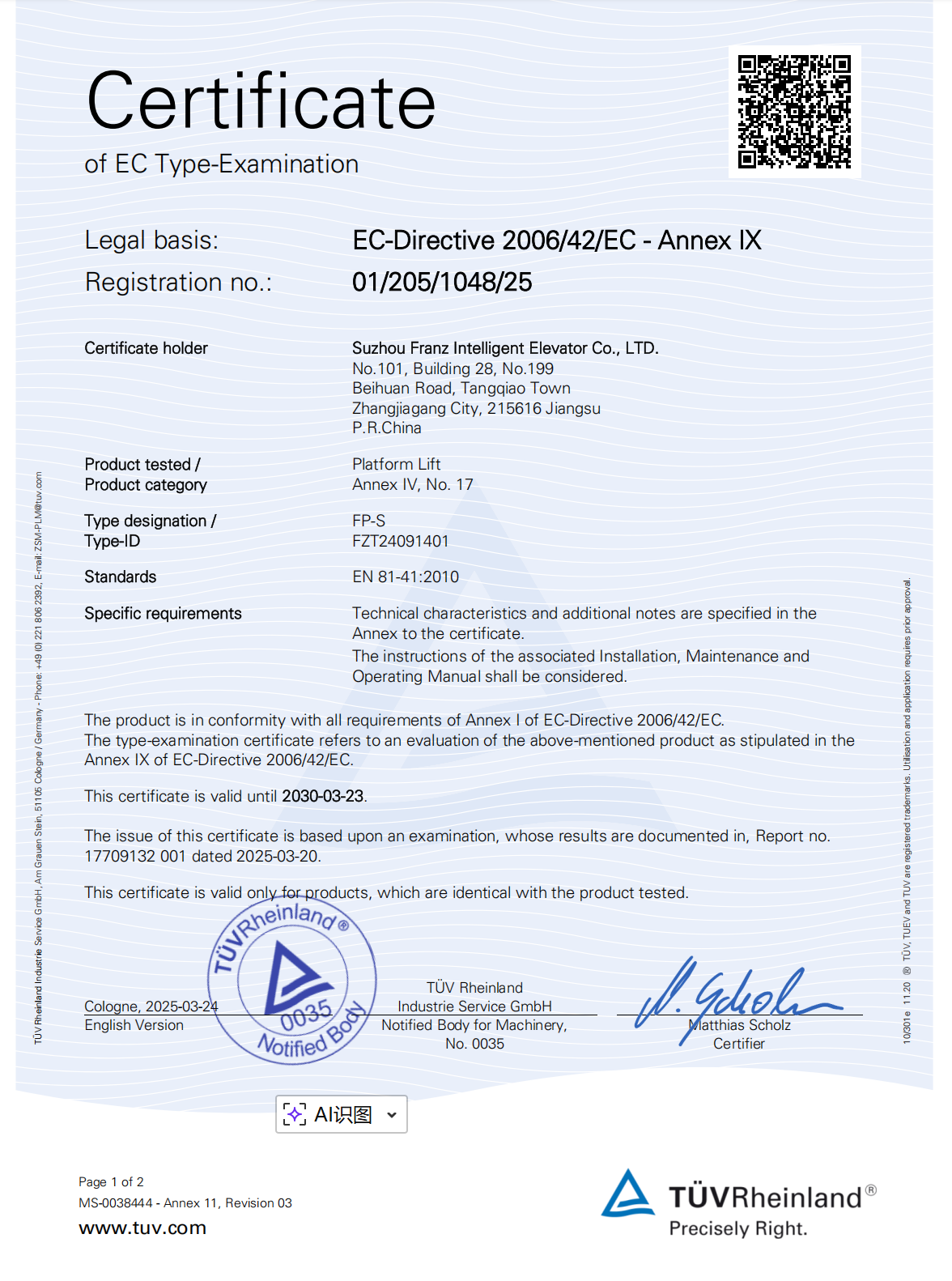
The TÜV Rheinland EC Type-Examination Certificate covers a defined product and market — one layer of compliance, not the whole of it.
Planning a Home Lift Project?
FRANZ Intelligent Elevator Co., Ltd. manufactures shaft-built cabin lifts, glass lifts and platform lifts at its 30,000 m² facility in Suzhou, with an annual output of 6,000 units, a 32-engineer R&D team, and more than 220 showrooms across five continents and over 30 countries.
Download the product brochure for full specifications and certification details: FRANZ Home Lift Product Brochure
For project-specific compliance questions, specification reviews or sample and quotation requests, contact the overseas team directly:
Liyi Luo, Director of Overseas Department
Email: luoll015@franzlift.com
WhatsApp: +86 18595625216
Website: en.franzlift.com
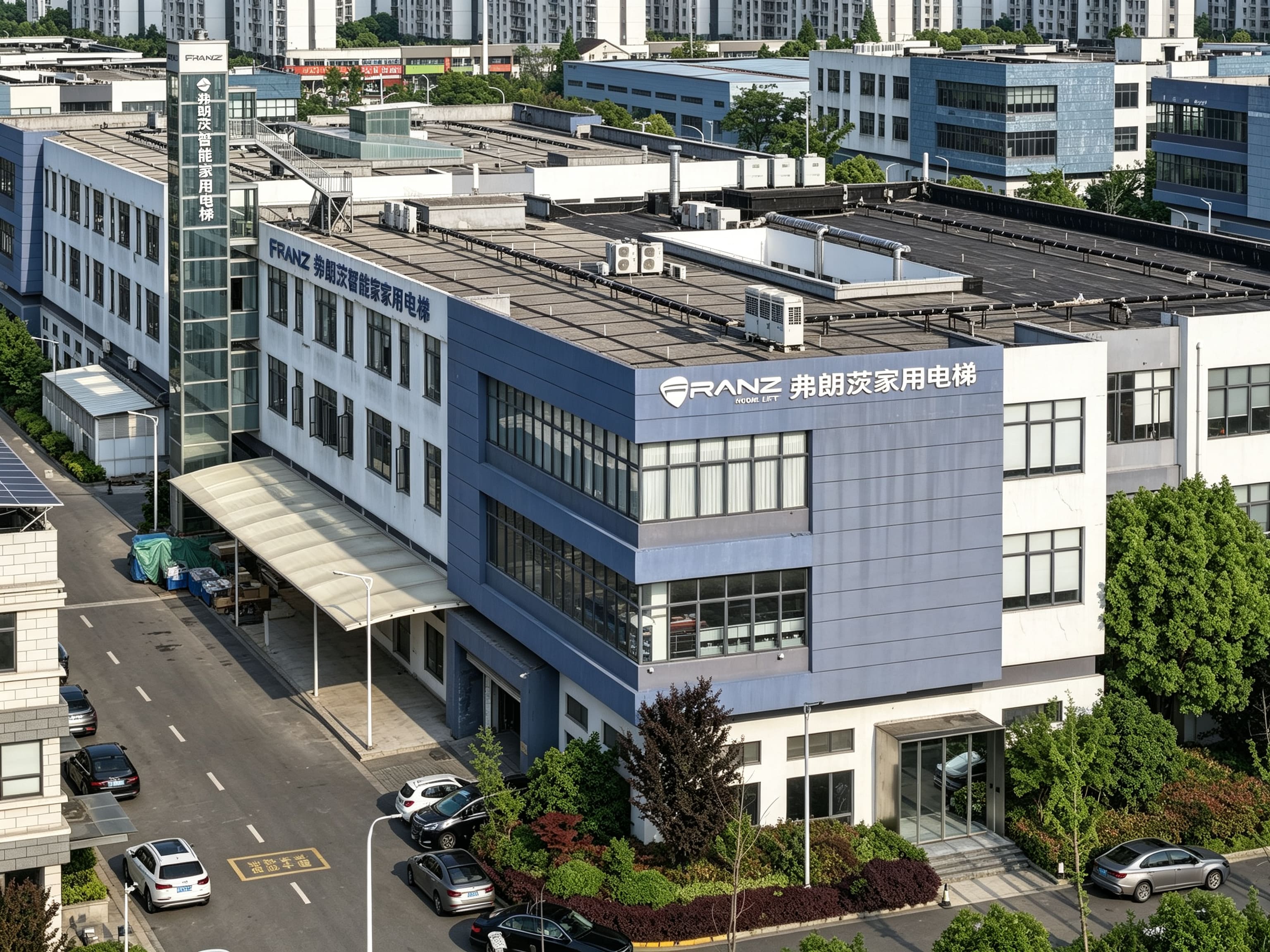
The FRANZ manufacturing facility in Suzhou, where every unit undergoes 100% testing before shipment.