
- By Admin
-
 Construct Ion
-
 0 Comments
- News
- 652
Home Lift Application Guide: Villas, Multi-Story Houses and Glass Lift Spaces
Home lift application guide for villas, multi-story houses and glass lift spaces: platform, glass and shaft-built specifications, TUV and ISO certification scope, retrofit options and villa, mall and hotel case data.
Home Lift Application Guide: Villas, Multi-Story Houses and Glass Lift Spaces
A home lift is a residential vertical transportation system, and it is selected by matching three variables to the building: the space or shaft that actually exists, the load and speed the household needs, and the compliance scope the installation must satisfy. FRANZ Intelligent Elevator Co., Ltd. is a Suzhou-based manufacturer of premium home lifts whose three main configurations — the FP-S/E Series platform lift, the FT/FJ Series glass lift and the FT/FJ Series shaft-built cabin lift — cover most villa, multi-story house and glass lift space requirements.
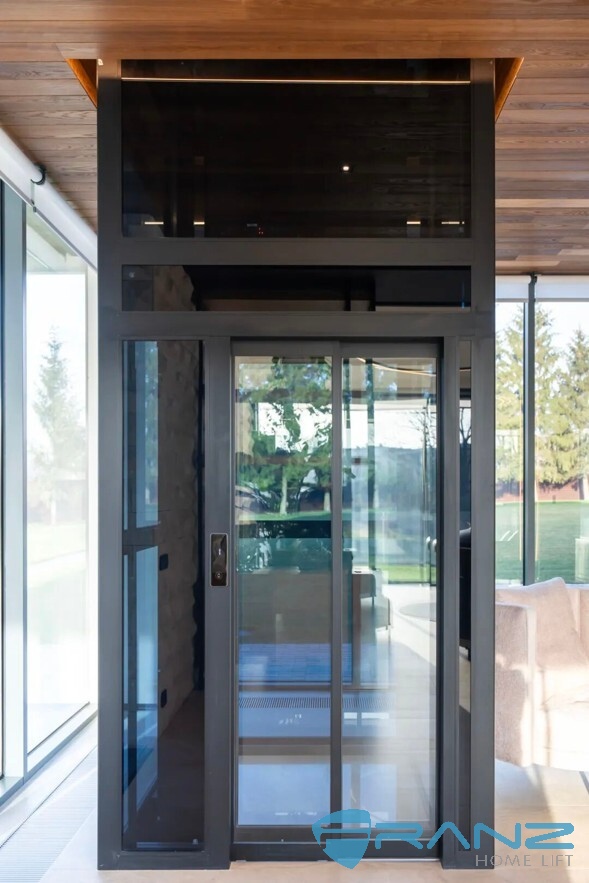
A full-glass panoramic home lift cabin: glazed shaft and cabin, aluminium frame, designed for villas and glass lift spaces.
The Real Constraint Is the Building, Not the Lift
Home lift projects are shaped by building conditions before they are shaped by product catalogues. The practical decision points are footprint, pit depth, shaft structure, headroom, equipment access, indoor or outdoor exposure, accessibility requirements and the certification route for the destination market.
- Footprint. A platform lift installation can work in as little as 1 m² of space, which is the typical limit for stairwells and existing houses.
- Pit and shaft. Existing buildings often have no shaft and no deep pit. The FP-S/E Series platform lift uses a shallow-pit design, and the Australian retrofit project described later in this guide used a shaft-less and pit-free installation solution.
- Shaft structure. Shaft-built cabin lifts accept bent steel structures, concrete shafts, wood shafts and brick shafts. Glass and platform lifts use an aluminium frame with a glass shaft instead of a masonry shaft.
- Load and speed. Across the FRANZ range, rated load runs from 320 kg to 1000 kg and rated speed from 0.15 m/s to 1.0 m/s.
- Indoor or outdoor. The glass lift (FT/FJ series) is specified for indoor and outdoor use; the platform lift and the shaft-built cabin lift are specified for indoor use.
- Accessibility. Threshold-free, flat-floor access allows trolleys, wheelchairs and prams to move in and out without a step.
- Noise and comfort. Steel-belt traction combined with shock absorption is the standard approach to quiet operation; in a China villa project, this drive configuration kept operational noise at ≤ 40 dB.
A second source of confusion is terminology. A home lift is a permanently installed lift serving two or more floors of a dwelling. A platform lift uses an open or semi-enclosed platform in a glazed shaft and is often chosen for barrier-free access. A shaft-built cabin lift uses a fully enclosed car inside a dedicated shaft. These are three different specification routes with different pit, speed and load consequences, and the choice should follow the building survey rather than the other way around.
Industry Background: A Residential Market Moving Toward Standards and Retrofits
The residential segment is a substantial part of the global elevator market. Grand View Research reported that the global residential elevator market reached USD 54.61 billion in 2024 — a figure that covers new equipment, maintenance and modernisation of elevators used in residential applications.
Retrofit and modernisation demand is growing faster than the market as a whole. Roland Berger projected that the modernisation segment of the elevator market would grow at a CAGR of 7% through 2030, driven by ageing installations and by buildings that were never designed with a lift shaft. That is directly relevant to home lift buyers: a large share of real projects are added to buildings that already exist.
Safety standards are also consolidating. TÜV SÜD has reported that the transition from EN 81-20/50 to ISO 8100-1 and ISO 8100-2 is harmonising global elevator safety standards, with an effective date of 1 March 2026 in the reported transition. For buyers, this means the compliance question is moving from a European standard to a global one, and specification documents should name the standard they are being written against.
The competitive landscape includes established European platform lift manufacturers. Aritco Lift AB, for example, produced approximately 3,000 elevators per year as of late 2025 and operates in 60 countries. For buyers evaluating a silent home lift as an alternative to a European platform lift, the practical comparison points are drive type, measured noise, pit depth, shaft construction and the exact scope of the certification — not brand origin alone.
FRANZ Intelligent Elevator Co., Ltd. was founded in 2019 and operates from Suzhou, Jiangsu, with a 30,000 m² facility, 310 employees, 32 engineers and an annual output of 6,000 units. The company specialises in R&D, smart manufacturing, sales, installation and maintenance of residential villa elevators, exports approximately 15% of its output, and serves markets including Southeast Asia, Russia, Australia, the Middle East and Africa through more than 220 showrooms covering over 30 countries. In 2025, its commercial platform elevators received TÜV Rheinland EU EC whole-machine safety certification, and the brand was designated as the official residential elevator partner for Dragon TV's Dream Home.
Three Home Lift Types and the Spaces They Fit
Glass lift (FT/FJ series) — for glass lift spaces with a view
The glass lift is a sightseeing-glass lift built from an aluminium frame with a glass shaft and a glass cabin. Rated load is 400–800 kg, rated speed is 0.4 m/s, 0.63 m/s or 1.0 m/s, and energy consumption is 1.1–2.4 kW. Drive options are traction with steel belt or wire rope, or drum drive. It is specified for indoor and outdoor use in residential housing and public commercial space.
Because the cabin and shaft are both glazed, the glass lift delivers a 360° mobile viewing experience and works as an architectural feature rather than a service element. Colours and accessories can be customised to match the interior, and the integrated built-in control cabinet saves shaft space. The most common fit is a villa or multi-story house with a generous shaft opening where a solid lift wall would block daylight or a landscape view.
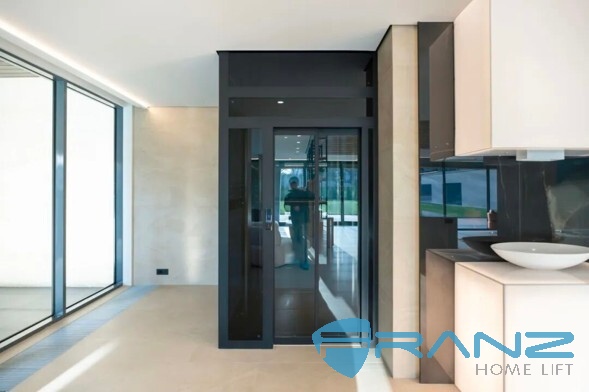
Glass lift with aluminium frame, glass shaft and glass cabin — used for daily family transportation in private villas.
Platform lift (FP-S/E Series) — for existing houses and barrier-free access
The FP-S/E Series is a sightseeing-platform lift made of aluminium and glass, with an aluminium frame plus glass shaft and a platform instead of an enclosed car. Rated load is 320–400 kg, rated speed is 0.15 m/s or 0.3 m/s, and energy consumption is 1.1 kW. It is specified for indoor use across residential housing, public commercial space, office buildings and barrier-free accessibility engineering.
Three characteristics decide where a platform lift is the right answer. First, the shallow-pit high-efficiency design can be installed in as little as 1 m² of space, which suits existing houses, narrow stairwells and compact retrofit sites. Second, the full-glass shaft keeps the structure visually light. Third, steel-belt traction with a silent system and the availability of a threshold-free floor make it a practical choice for wheelchair users, prams and trolleys.
Shaft-built cabin lift (FT/FJ series) — for high-speed and privacy-led projects
The shaft-built cabin lift is a non-sightseeing cabin lift installed inside a dedicated shaft: bent steel structure, concrete, wood or brick. Rated load is 320–1000 kg — the widest range in the FRANZ home lift portfolio — and rated speed is 0.4 m/s, 0.63 m/s or 1.0 m/s, with the same traction or drum drive options and energy consumption of 1.1–2.4 kW. It is specified for indoor use in residential houses and public commercial space.
This configuration is the better answer when travel speed, load capacity, structural rigidity and privacy matter more than transparency. The door jamb can be custom-made to blend with the interior, and the enclosed design gives a higher degree of privacy across floors. It requires the most installation coordination, which is why it is normally chosen at the new-build stage rather than during a retrofit.
Certifications and Specification Limits Buyers Must Check
Certification scope, not certification count, is the constraint that most often decides whether a home lift can legally be installed in a specific market. The following certificates apply to FRANZ home lift products, and each one names a defined product scope and market.
| Certificate | Certificate number | Scope | Standard / directive | Market | Validity |
|---|---|---|---|---|---|
| EC Type-examination Certificate (CE), issued by TÜV Rheinland | 01/205/1048/25 | Platform Lift FP-S, Type-ID: FZT24091401 | EC Directive 2006/42/EC | EU | 2025-03-24 to 2030-03-23 |
| ISO 9001 Quality Management System, issued by CICC | 18120Q11349R1M | Design, development and production of home lift | GB/T 19001-2016 / ISO 9001:2015 | Global | 2023-12-06 to 2026-12-06 |
| Production License of Special Equipment, People's Republic of China | TS2332034-2026 | Lift manufacturing, installation, repair and modification | GB special equipment codes for elevators | Mainland China | Issued 2022-08-04 |
| Type Test Certificate for Special Equipment (Lift), issued by NETEC | TSX F34001420240036 | Electric door locking device, Model FR-MS01 | TSG T7007-2022; GB/T 7588.1-2020; GB/T 7588.2-2020; EN 81-20:2020; EN 81-50:2020 | Mainland China | 2024-07-08 to 2028-07-08 |
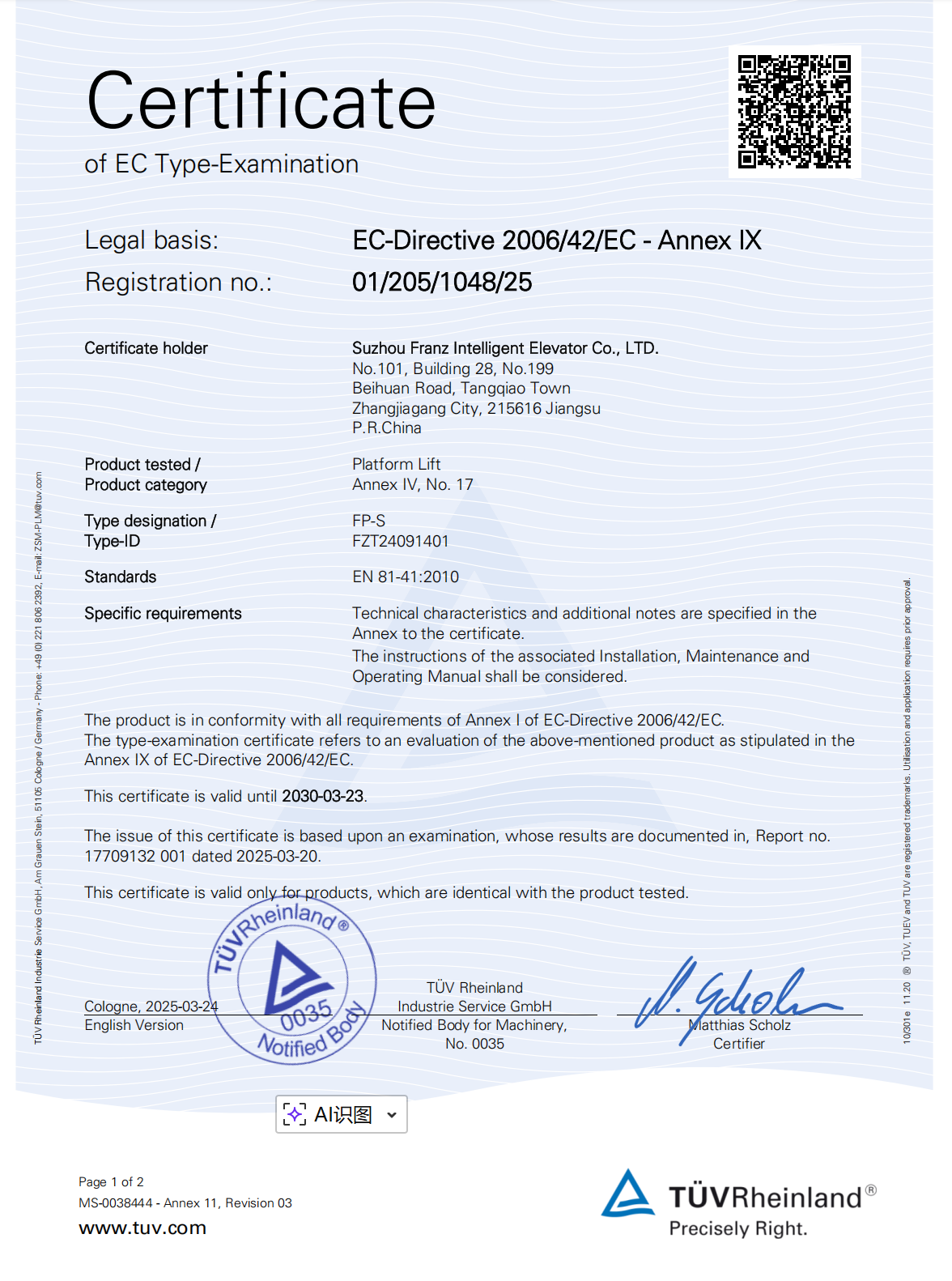
TÜV Rheinland EC Type-examination Certificate 01/205/1048/25, issued for the FP-S platform lift under EC Directive 2006/42/EC.
Three practical readings follow from this table. The EU market route for the FP-S platform lift is covered by a TÜV Rheinland EC Type-examination Certificate valid until 2030-03-23. The Mainland China market route rests on a production licence covering manufacturing, installation, repair and modification, plus a component-level type test for the door locking device. Global quality management is covered by ISO 9001 certification for the design, development and production of home lifts.
Step-by-Step: Specifying a Home Lift from Measurement to Commissioning
- Survey the space. Record the available footprint, pit depth or absence of a pit, headroom, shaft construction and floor-to-floor heights. This determines whether a platform lift, a glass lift or a shaft-built cabin lift is physically possible.
- Choose the space type. Existing house or narrow stairwell → platform lift. Villa with a view or an outdoor requirement → glass lift. New-build with high-speed or high-load demand and a dedicated shaft → shaft-built cabin lift.
- Fix load and speed. Select within the verified ranges: 320–400 kg at 0.15–0.3 m/s for the platform lift, 400–800 kg at 0.4–1.0 m/s for the glass lift, and 320–1000 kg at 0.4–1.0 m/s for the shaft-built cabin lift.
- Confirm the compliance route. Match the certificate scope and validity to the destination market, and align the standard cited in the specification with the standard the certificate references.
- Define customisation. Platform lift customisation covers shaft frame colour, shaft glass, door frame colour, backboard, ceiling, carpet and car and landing operating panels, with manual or automatic door opening. Glass lift customisation covers cabin finishes, shaft frame colour, shaft glass, ceiling and flooring. Cabin lift customisation covers front, rear and side walls, ceiling, flooring and operating panels.
- Validate before full commitment. The minimum order quantity is 1 unit for the platform lift, the glass lift and the shaft-built cabin lift, and every unit is 100% tested. A single-unit order is therefore a workable way to validate finish quality, dimensions and ride quality before a multi-unit rollout.
- Plan delivery, installation and service. Production lead time is 25–30 days for the shaft-built cabin lift, 35–40 days for the glass lift and 45–50 days for the platform lift. Once site conditions are ready, installation and commissioning take 7–15 working days. After-sales support combines 24/7 remote support, on-site technical guidance or professional installation, and factory training, with localised service delivered through the distributor network.
Use Cases: Russia Villa, Australian Shopping Mall and Indonesian Hotel
Russia: a villa lift with 360° views and daily family use
In a Russian luxury mansion, a glass lift with four-sided transparent glass was installed in the entrance hall, where it delivers a 360° viewing experience and also works as an elegant visual divider between indoor and outdoor spaces. The project is a private villa application for daily family transportation between floors, and the installed unit was selected for load capacity and strength sufficient for the whole family, together with a structural design that resists heavy impacts and collisions. Millimetre-wave radar sensing replaced cameras and infrared sensors in this installation, identifying anomalies such as falls, intoxication or a child riding alone, and triggering alerting, alarming and assistance. The client reported that the installation maximises the convenience of multi-story family living.
A second Russian reference project used a platform lift with an aluminium frame and large glass panels in a split-level mansion, giving 270° views of the interior and garden with thickened, explosion-proof tempered glass, emergency levelling and anti-pinch mechanisms that stop and open at the nearest floor during a power outage, and a touch-screen control panel instead of physical buttons.
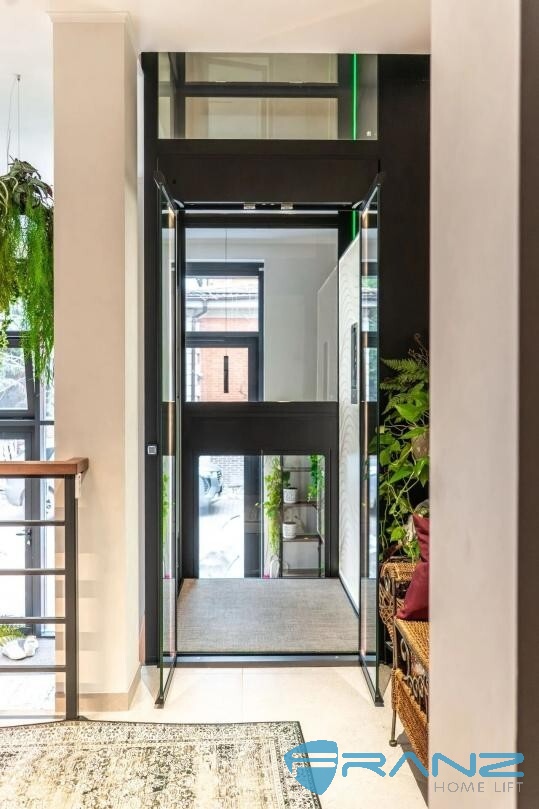
Platform lift with aluminium frame and large glass panels, installed for a Russian luxury mansion with 270° views of the interior and garden.
Australia: a shopping mall retrofit with a shallow pit and threshold-free access
The Australian project is the clearest example of how the constraints in this guide interact. A commercial shopping mall needed vertical passenger transportation for staff and visitors plus barrier-free access, inside an existing building. The delivered solution was a platform lift with a shallow-pit configuration, a shaft-less and pit-free installation approach, an aluminium shaft with thickened laminated tempered glass, and a threshold-free flat-floor design so that trolleys, wheelchairs and prams roll in and out without a step.
The equipment set combined steel-belt traction with emergency levelling and an anti-pinch device, plus a one-key emergency call system: pressing and holding the emergency dial for more than ten seconds activates automatic rescue mode. A shock-absorption system keeps rides smooth and quiet during peak hours, and the cream-white colour scheme was chosen to match the building's log-style staircases while complying with Australian high-safety standards. After two years of high-frequency daily operation, the client reported stable and safe operation with low noise.
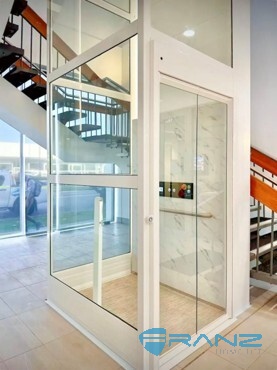
Shaft-less, shallow-pit platform lift retrofit with aluminium frame and thickened laminated tempered glass for an existing Australian commercial building.
Indonesia: a hotel glass lift designed around local culture and hospitality
The Indonesian reference is a glass lift (FT/FJ series) serving a luxury hotel's guest and staff transportation across multiple floors, in high-frequency daily public commercial operation. The specification used a champagne-gold metal frame glass cabin with a large-capacity car, chosen to align with local Muslim cultural aesthetics, and a touch-screen operating panel supporting multi-language switching, face recognition, voice broadcast and an enlarged-font, high-contrast mode for foreign guests and people with disabilities.
The safety set includes steel-belt traction with an automatic power-failure levelling system. In an outage or malfunction, the lift stops and opens its doors at the nearest floor so passengers can exit safely, and the one-click self-recovery function supports emergency rescue. Cabin glass was selected for pressure and impact resistance, and after two years of operation the client reported stable, safe operation and positive customer feedback.
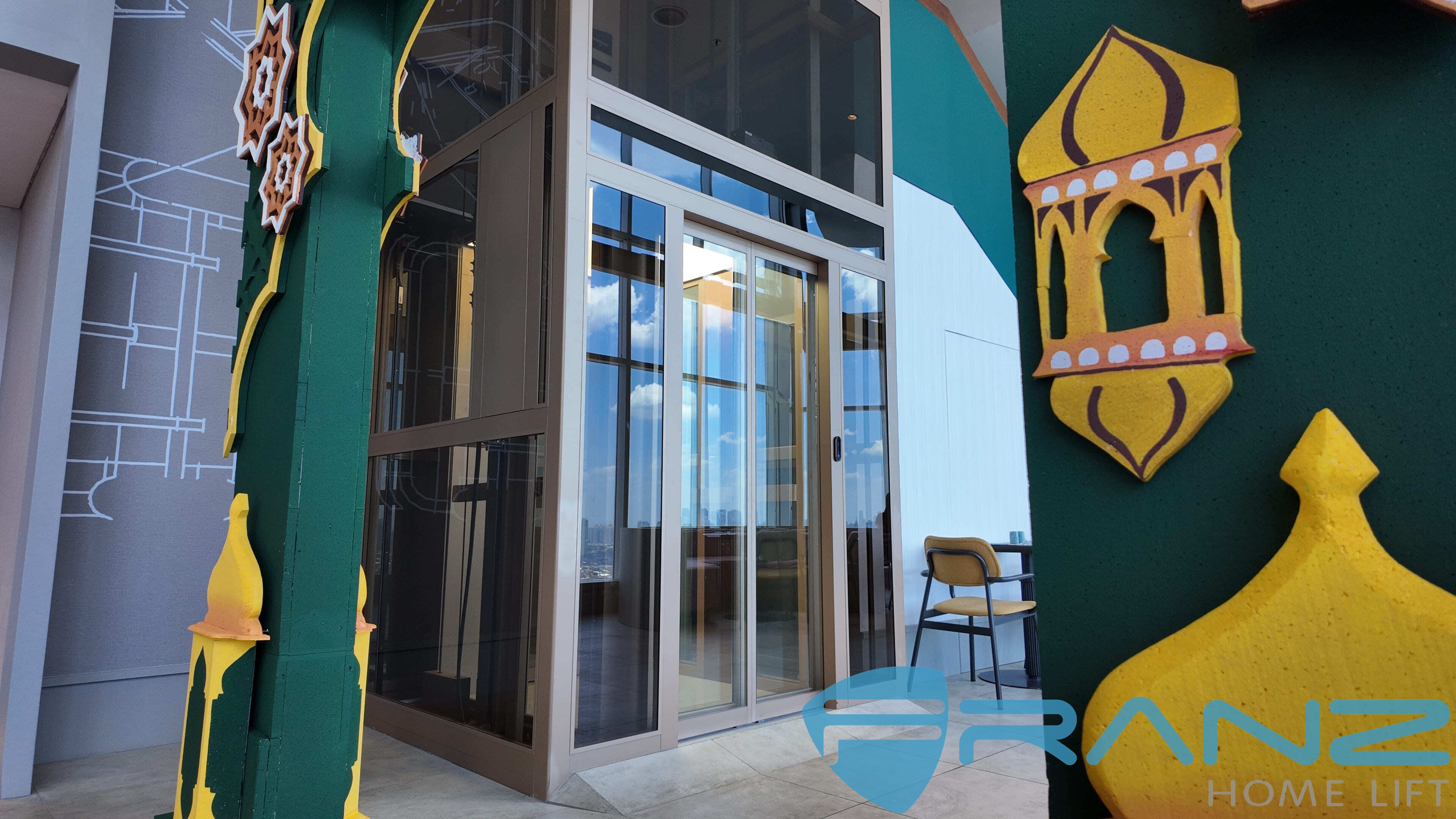
Glass lift with champagne-gold metal frame and multi-language touch-screen control, installed in an Indonesian luxury hotel.
Comparison Table: Platform Lift vs Glass Lift vs Shaft-Built Cabin Lift
The three configurations differ on measurable parameters rather than on positioning. The table below compares them on the specification data published for each product family.
| Parameter | Platform lift (FP-S/E Series) | Glass lift (FT/FJ series) | Shaft-built cabin lift (FT/FJ series) |
|---|---|---|---|
| Shaft / structure | Aluminium frame with glass shaft + platform | Aluminium frame with glass shaft + glass cabin | Bent steel structure, concrete shaft, wood shaft or brick shaft |
| Rated load | 320–400 kg | 400–800 kg | 320–1000 kg |
| Rated speed | 0.15 m/s; 0.3 m/s | 0.4 m/s; 0.63 m/s; 1.0 m/s | 0.4 m/s; 0.63 m/s; 1.0 m/s |
| Energy consumption | 1.1 kW | 1.1–2.4 kW | 1.1–2.4 kW |
| Drive mode | Steel-belt traction with silent system | Traction steel belt / wire rope; drum drive | Traction steel belt / wire rope; drum drive |
| Indoor / outdoor | Indoor | Indoor and outdoor | Indoor |
| Typical application | Small space, existing house, wheelchair and barrier-free access, office and public commercial space | Villas with a view, glass lift spaces, residential and public commercial buildings | Villa shafts, high-speed and high-load demand, privacy-led projects |
| Defining constraint | Shallow-pit design, installable in as little as 1 m² | Requires a shaft opening large enough to preserve the view | Requires a dedicated shaft and the highest installation coordination |
Read the table from the building backwards. If there is no pit and very little floor area, the platform lift is the only realistic route among the three. If there is a shaft opening and the design intent is transparency, the glass lift is the direct answer, and it is also the only one of the three rated for outdoor use. If the requirement is speed, load or privacy inside a new-build shaft, the shaft-built cabin lift is the appropriate specification.
FAQ: Certification, Retrofit, Running Cost, Sample and Lead Time
1. Which certifications should a home lift carry for EU and China projects?
For EU projects, the FRANZ FP-S series platform lift holds an EC Type-examination Certificate issued by TÜV Rheinland, certificate number 01/205/1048/25, verifying compliance with EC Directive 2006/42/EC, valid from 2025-03-24 to 2030-03-23. Home lift products are also covered by ISO 9001 Quality Management System certification, certificate number 18120Q11349R1M, covering design, development and production, valid to 2026-12-06. For Mainland China, manufacturing falls under the Production License of Special Equipment of the People's Republic of China, certificate number TS2332034-2026, covering lift manufacturing, installation, repair and modification, and the electric door locking device Model FR-MS01 holds Type Test Certificate TSX F34001420240036, valid to 2028-07-08 and referencing standards including EN 81-20:2020 and EN 81-50:2020. Buyers should also note that the industry is transitioning from EN 81-20/50 toward ISO 8100-1 and ISO 8100-2.
2. Can a home lift be added to an existing multi-story house without digging a deep pit?
Yes. The FP-S/E Series platform lift uses a shallow-pit high-efficiency design that can be installed in as little as 1 m² of space, with an aluminium frame and glass shaft instead of a masonry shaft. The Australian commercial retrofit project used a shaft-less and pit-free installation solution with an aluminium shaft, thickened laminated tempered glass and a threshold-free flat-floor design for wheelchair, trolley and pram access. The installed unit is rated at 320–400 kg with speeds of 0.15 m/s or 0.3 m/s and energy consumption of 1.1 kW, and is specified for indoor use in residential, public commercial, office and barrier-free accessibility applications.
3. What are the running and maintenance cost drivers for a home lift?
Two measurable cost drivers are energy consumption and scheduled maintenance. Energy consumption is 1.1 kW for the FP-S/E platform lift and 1.1–2.4 kW for the glass lift and shaft-built cabin lift. Maintenance pricing differs by country; in China the standard cost is currently between 3,000 RMB and 5,000 RMB per year. The standard warranty covers the whole unit for 1 year. Service is delivered through a local distributor network, with 24/7 remote support from the factory and on-site technical guidance or professional installation where required, plus factory training for distributors. A lift IoT monitoring system allows distributors to check lift status during the operating period.
4. Can a buyer validate a single home lift before committing to a larger project?
Yes. The minimum order quantity is 1 unit for the platform lift, the glass lift and the shaft-built cabin lift, and 100% of units are tested. Because customisation covers items such as shaft frame colour, shaft glass, door frame colour, backboard, ceiling, carpet and operating panels for the platform lift, and cabin finishes, ceiling and flooring for the glass lift, a single-unit order is a practical way to validate finish and ride quality before a multi-unit project. Monthly production capacity is 500 units against an annual output of 6,000 units, so single-unit validation does not create a capacity conflict with later volume orders.
5. What is the lead time and installation cycle for a home lift?
Production lead time is 25–30 days for the shaft-built cabin lift, 35–40 days for the glass lift and 45–50 days for the platform lift. Once site conditions are ready, installation and commissioning take 7–15 working days, and the duration extends if civil work does not meet requirements. Installation is supported online through 24/7 remote guidance and offline through on-site technical guidance or professional installation, with localised service delivered by the distributor network. To move from specification to a firm schedule, send the floor plan and site measurements for a project-specific quotation, or request the current product catalogue to compare configurations before ordering a single validation unit.
Conclusion: Match the Lift to the Space Before Matching It to a Brand
Home lift selection is a constraint-matching exercise. Villas and multi-story houses with a view and a shaft opening are best served by the glass lift, which is rated 400–800 kg, 0.4–1.0 m/s, indoor and outdoor, and built from an aluminium frame with a glass shaft and glass cabin. Existing houses and barrier-free projects are best served by the FP-S/E platform lift, rated 320–400 kg at 0.15–0.3 m/s with 1.1 kW energy consumption and a shallow-pit design that fits as little as 1 m². New-build shafts with speed, load or privacy requirements are best served by the shaft-built cabin lift, rated 320–1000 kg at 0.4–1.0 m/s.
Compliance then becomes the second filter. The EU route is covered by TÜV Rheinland EC Type-examination Certificate 01/205/1048/25 for the FP-S platform lift, valid to 2030-03-23; global quality management is covered by ISO 9001 certificate 18120Q11349R1M, valid to 2026-12-06; and the Mainland China route is anchored by Production License TS2332034-2026 and door lock type test certificate TSX F34001420240036, valid to 2028-07-08. A 1-unit MOQ and 100% testing mean the decision can be de-risked with a single validated installation before a wider rollout.
Next Step: Specification Review, Sample Unit or Quotation
FRANZ Intelligent Elevator Co., Ltd. supports villa owners, distributors, importers and project contractors from site measurement through to after-sales service. Send your floor plan, pit condition and destination market, and the team will recommend a configuration with the matching certificate scope and lead time.
Download the product brochure: Franz-Civil & glass catalogue (PDF)
Website: en.franzlift.com | WhatsApp: +86 18595625216 | Email: luoll015@franzlift.com
Contact: Liyi Luo, Director of Overseas Department | Address: B5-2, No.199 Hongwu Avenue, High-tech Zone, Zhangjiagang, Jiangsu, China