
- By Admin
-
 Construct Ion
-
 0 Comments
- News
- 368
Home Lift Application Guide: Cultural Adaptation for Luxury Hotel Installations
Home lift application guide for luxury hotels: cultural adaptation, impact-resistant glass, accessible controls, automatic leveling — based on a FRANZ Indonesia project.
Home Lift Application Guide: Cultural Adaptation for Luxury Hotel Installations
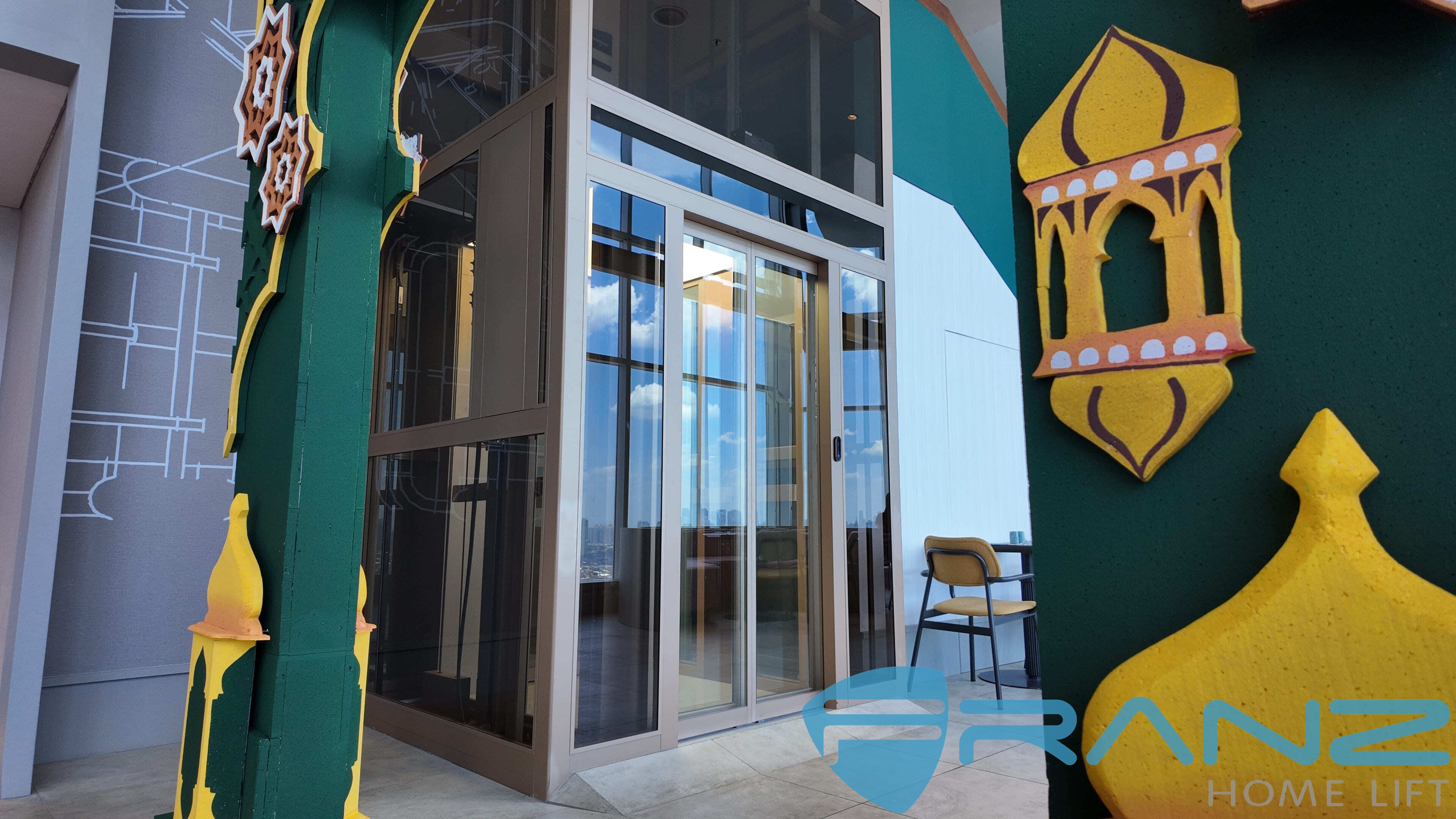
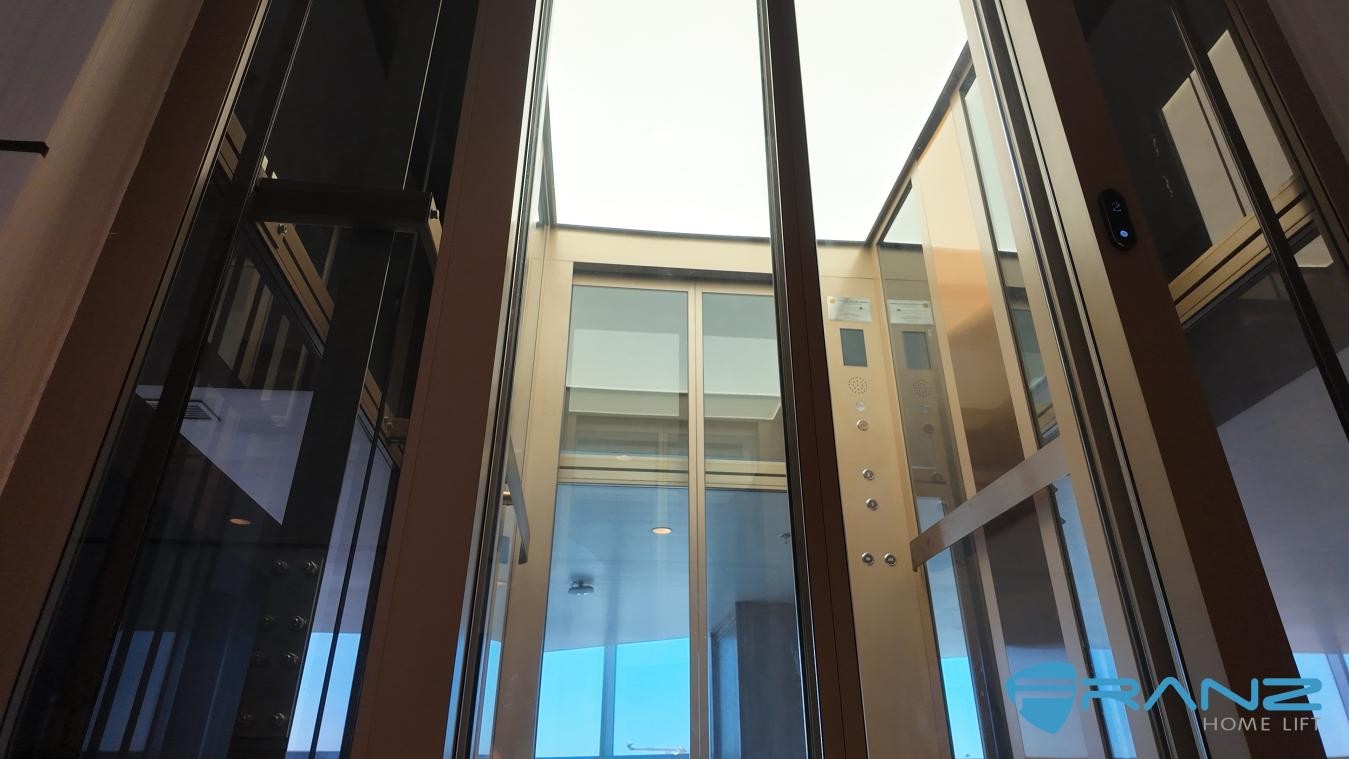
Adapting a home lift for a luxury hotel is a design and compliance exercise, not a catalogue purchase. The clearest reference point is a completed installation: a FRANZ FT/FJ series glass lift supplied to a luxury hotel in Indonesia as a single unit for hotel passenger transportation. Its champagne gold exterior was chosen to align with the local Muslim cultural characteristics and customs. The cabin glass and spacious layout were specified for high pressure and impact resistance. The touchscreen control panel supports facial recognition and multi-language switching, with high-contrast mode, font magnification and voice announcement for foreign guests and people with disabilities. The automatic leveling system stops and opens the doors at the nearest floor during a sudden power outage or a lift malfunction, supported by a one-click self-recovery function for emergency rescue. The project ran over a two-year duration, and the reported result was stable and safe operation with good customer feedback.
This application guide breaks that project down into the decisions a hotel developer, consultant or procurement team actually has to make. It covers where a hotel installation diverges from a private villa installation, the industry context that shapes supplier selection, the adaptations applied in the Indonesia project, a step-by-step specification sequence, comparable use cases in other markets, and a comparison of the three FRANZ lift families available for this class of work.
Problem Definition: Why a Villa Lift and a Hotel Lift Are Not the Same Requirement
A private residence serves a small, known group of users: family members who learn the controls once and use them for years. A hotel serves guests who have never seen the building before, staff who operate the lift dozens of times per shift, and travellers who may not read the local language. When the same residential lift platform is applied to both, the hardware may be technically identical while the requirements are not.
Five requirement gaps separate a villa installation from a hotel installation, and each one has to be converted into a specification line before the order is placed.
- Cultural and visual alignment. Finishes in a hotel lobby are read by every guest. A palette that appears neutral in one market can appear impersonal or inappropriate in another. In the Indonesia project, exterior colour was treated as a cultural decision rather than a cosmetic one: a champagne gold exterior design was selected to align with the local Muslim cultural characteristics and customs, making the installation more appealing to customers.
- Safety envelope under public use. Cabin glass in a hotel is exposed to luggage trolleys, crowding and accidental impact far more than domestic glass is. The Indonesia specification therefore called for cabin glass and a spacious layout with high pressure and impact resistance, delivering greater safety for passengers and staff and reliable protection for all riders.
- Accessibility across languages and abilities. A hotel lift must be usable by guests who speak a different language, by guests with reduced vision, and by guests with disabilities, without requiring a member of staff to operate the lift for them.
- Emergency behaviour with passengers inside. A villa lift can be stopped and dealt with domestically; a hotel lift carrying guests has to return them to a floor and open its doors.
- Coordination with a fixed opening date. Hospitality projects are usually tied to a launch schedule, so production lead time, shipping terms and on-site commissioning time become commercial risks rather than logistics details.
None of these five points can be resolved by choosing a standard residential lift from a price list. They have to be written into the specification, quoted, tested before shipment, and commissioned on site.
Industry Background: Where Residential Lifts Meet Hospitality
The category is large and still expanding. The global residential elevator market reached USD 54.61 billion in 2024, according to Grand View Research. Modernization work inside that market is projected to grow at a CAGR of 7% through 2030, based on Roland Berger's elevator market outlook, which is directly relevant to hospitality and retrofit projects built inside existing structures rather than new shafts.
Regulation is converging at the same time. The transition from EN 81-20/50 to ISO 8100-1 and ISO 8100-2 is harmonising global elevator safety standards, as described by TÜV SÜD. For a hotel developer, the practical consequence is that certification evidence must match two variables precisely: the market where the building stands, and the equipment family actually being supplied.
Specialisation is visible on the supply side. Aritco, the Swedish platform lift manufacturer, produced approximately 3,000 elevators per year as of late 2025 and operates in 60 countries, which illustrates how focused manufacturers scale within the residential and light-commercial lift category rather than across general elevator portfolios.
FRANZ Intelligent Elevator Co., Ltd. is a Suzhou-based home lift manufacturer founded in 2019, operating a 30,000 m² factory with 310 employees, including a 32-engineer R&D team and an annual output of 6,000 units. Exports represent 15% of production, with main markets in Southeast Asia, Russia, Australia, the Middle East and Africa; the company runs more than 220 showrooms and serves over 30 countries, including Indonesia. In 2025, its commercial platform elevators received the TÜV Rheinland EU EC whole-machine safety certification. The company also develops a proprietary active millimeter-wave radar situational awareness safety system for residential lifts.
Detailed Solution: How FRANZ Adapted a Glass Lift to an Indonesian Luxury Hotel
The product platform: FT/FJ series glass lift
The lift supplied to the Indonesia hotel belongs to the FT/FJ series glass lift family. Its shaft is an aluminium frame with a glass shaft plus a glass cabin; load capacity ranges from 400 kg to 800 kg; speed is 0.4 m/s, 0.63 m/s or 1.0 m/s; drive mode is traction steel belt or wire rope, or drum drive; energy consumption is 1.1 kW to 2.4 kW; and the product is rated for indoor and outdoor use. Its applicable industries are residential housing and public commercial space, which is the technical basis for deploying it in a hotel circulation area.
Adaptation 1: Treating cultural fit as an engineering input
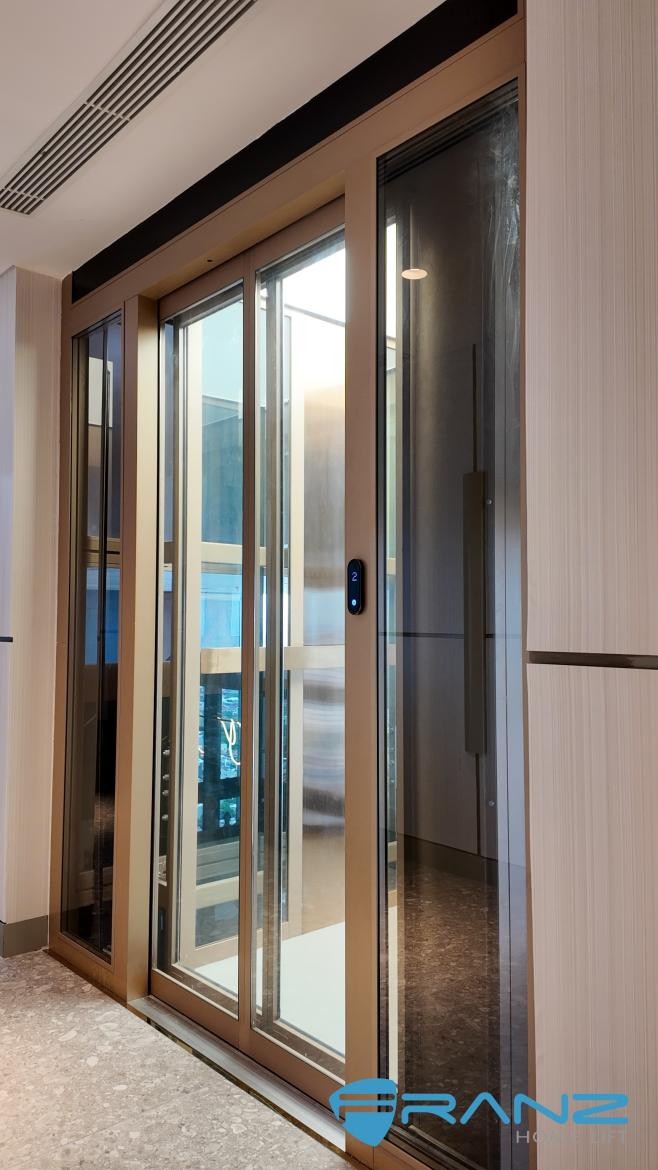
Design localisation in hospitality is not a decoration decision taken after engineering. In the Indonesia project, the exterior design was specified as champagne gold so that the lift aligned with the local Muslim cultural characteristics and customs and read as part of the building's identity rather than as imported equipment. That outcome depends on the manufacturer being able to change the shell of the product without changing the certified machine underneath.
For the FT/FJ series glass lift, the configurable surfaces include shaft frame colour, shaft glass, ceiling, flooring, and the car and hall operating panels (COP/HOP). Door opening can be specified as manual or automatic. FRANZ supports this level of customisation across its home lift range, and also provides OEM and ODM services where a hotel brand, developer or distributor needs the product delivered under its own specification. In the Indonesia project, one unit was enough to establish that relationship.
Adaptation 2: A safety envelope sized for public circulation
Hotel traffic is heavier and less predictable than household traffic. The Indonesia specification addressed this with cabin glass and a spacious layout engineered for high pressure and impact resistance, which delivers greater safety for passengers and staff and reliable protection for all riders. The glass cabin also keeps the lobby visually open, which is why glass lifts are frequently chosen for hospitality interiors in the first place.
Where a project wants active rather than passive safety, FRANZ equips its residential lifts with a proprietary active millimeter-wave radar situational awareness safety system. The same technology family is used in the company's other projects to identify abnormal situations such as intoxication, falls or children riding alone, and to trigger alerting, alarming and assistance. The point for a hotel operator is that safety specification can be layered onto the same platform rather than requiring a different machine.
Adaptation 3: Accessibility for foreign guests and guests with disabilities
An international hotel cannot assume that every user reads the same language or can read at all. The Indonesia lift was therefore fitted with a touchscreen control panel supporting facial recognition and multi-language switching. It includes a high-contrast mode, font magnification and voice announcement, which makes it highly accessible for foreign guests and people with disabilities. For hotel management, this reduces the number of guests who need staff assistance simply to reach their floor, which is an operational benefit as much as a service one.
Adaptation 4: Automatic leveling and self-recovery during power failures
Power instability is a real operating condition in many hospitality markets, and an occupied lift that stops between floors is both a safety event and a service event. The Indonesia installation uses an automatic leveling system: in emergencies such as sudden power outages or elevator malfunctions, the lift stops and opens its doors at the nearest floor to ensure safe passenger exit. A one-click self-recovery function then facilitates emergency rescue and maximises rider safety. This is a specification line that a buyer should confirm in writing, because the difference between a lift that simply stops and a lift that levels and releases its passengers is a difference in system design, not in maintenance.
Adaptation 5: Project scale, duration and outcome
The Indonesia project was delivered as one unit for hotel passenger transportation. The duration recorded for the project is two years, which is typical for hospitality work where lift installation is sequenced around structural, façade and fit-out packages rather than delivered as a standalone order. The reported result was stable and safe operation with good customer feedback. For a buyer preparing a similar project, the useful lesson is that the adaptation decisions were settled before production, not corrected after handover.
Adaptation map for the Indonesia project
| Hotel requirement | Adaptation implemented | What it changes for the operator |
|---|---|---|
| Fit with local cultural expectations | Champagne gold exterior design aligned with local Muslim cultural characteristics and customs | The lift supports the building's design language instead of appearing as imported equipment |
| Protection of guests and staff in public circulation | Cabin glass and spacious layout with high pressure and impact resistance | Reliable protection for all riders under heavy, unsupervised traffic |
| Users who do not share one language or one ability profile | Touchscreen panel with facial recognition, multi-language switching, high-contrast mode, font magnification, voice announcement | Accessible for foreign guests and people with disabilities without staff assistance |
| Power outage or malfunction with passengers inside | Automatic leveling to the nearest floor plus one-click self-recovery | Safe passenger exit and faster emergency rescue |
| Delivery inside a long construction programme | One unit delivered and operated across a two-year project duration | Stable and safe operation reported, with good customer feedback |
Step-by-Step Breakdown: Specifying an Adapted Home Lift for a Hotel
- Define the duty profile. Record who will use the lift: guests, staff, guests with disabilities, luggage and service trolleys; how many floors; expected traffic peaks; and the cultural design expectations of the market. This step decides everything downstream.
- Match the lift family to the site. FRANZ's selection guidance for private residential use is straightforward: where a concrete or brick shaft already exists, a shaft-built cabin lift fits; where the shaft size is large, a glass lift is the natural choice; where space is limited or the lift is being added to an existing house, a platform lift is the practical solution. For commercial public use, the guidance recommends the commercial platform lift where EU certification or accessibility requirements for people with disabilities in public spaces apply. The Indonesia hotel case used the glass lift.
- Set the visual language before engineering. For the FT/FJ series glass lift, specify shaft frame colour, shaft glass, ceiling, flooring, COP/HOP, and manual or automatic door opening. Confirm the chosen palette against the local cultural context rather than against a showroom sample alone.
- Engineer the safety envelope. Confirm the impact and pressure performance required for cabin glass in a public setting. Where active safety is required, specify the millimeter-wave radar situational awareness system so that abnormal situations can be identified and escalated.
- Configure controls and accessibility. Decide which languages, accessibility modes and identification methods are needed. The Indonesia specification combined facial recognition, multi-language switching, high-contrast mode, font magnification and voice announcement in one touchscreen panel.
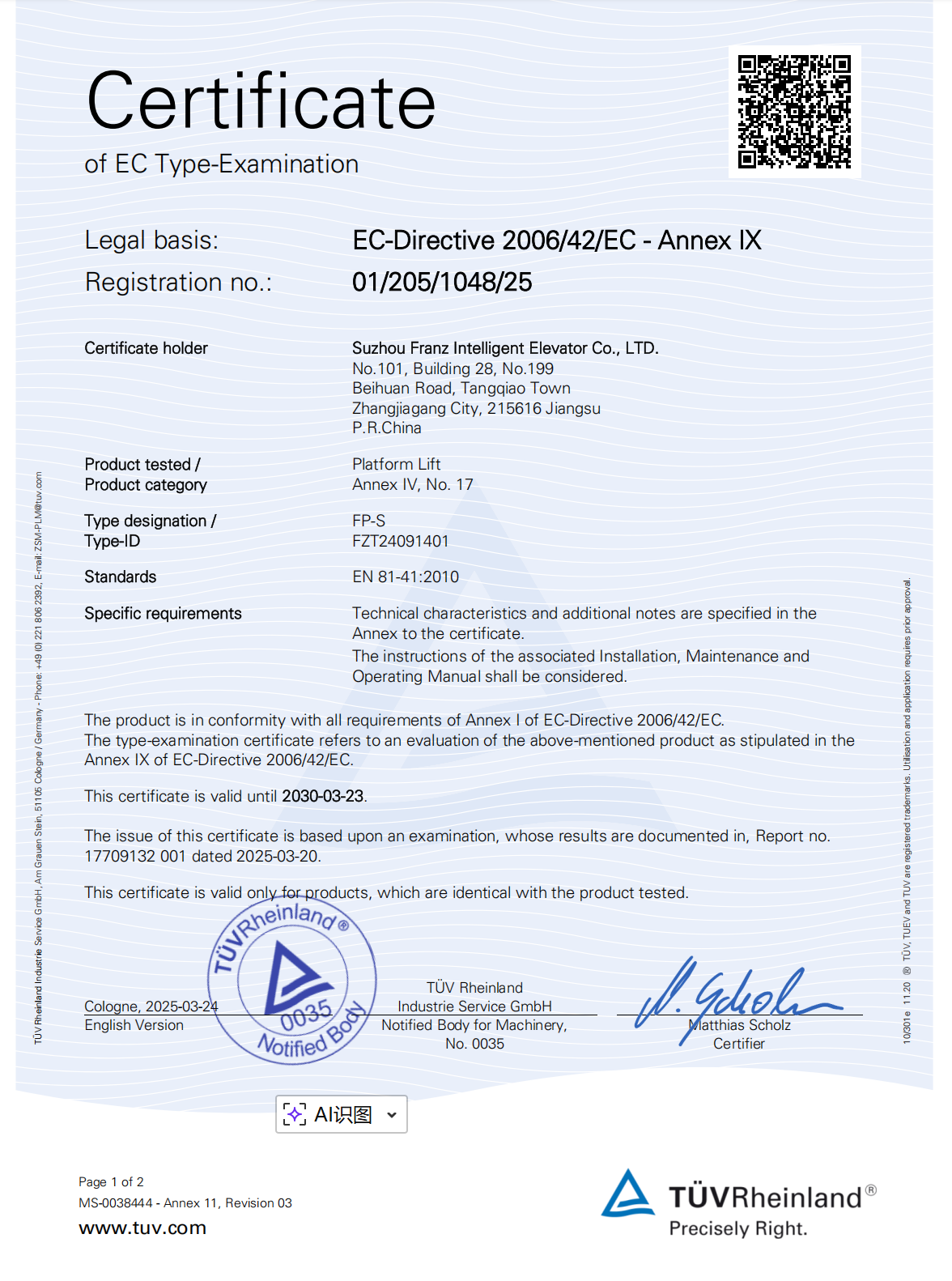
- Certify and verify. Match certification to market and equipment. FRANZ holds a TÜV Rheinland EC type-examination certificate (No. 01/205/1048/25) covering the FP-S platform lift under EC Directive 2006/42/EC, issued 24 March 2025 and valid to 23 March 2030. Its quality management system is certified to GB/T 19001-2016 / ISO 9001:2015 (certificate 18120Q11349R1M, issued 6 December 2023, valid to 6 December 2026) for the design, development and production of home lifts. Lift manufacturing, installation, repair and modification are covered by the Production License of Special Equipment TS2332034-2026, issued by the Jiangsu Provincial Market Supervision Administration. The electric door locking device (model FR-MS01) holds a Lift Safety Component Type Test Certificate, No. TSX F34001420240036, tested against TSG T7007-2022, GB/T 7588.1-2020, GB/T 7588.2-2020, EN 81-20:2020 and EN 81-50:2020. Acceptance of home lifts includes pre-shipment testing and factory testing procedures, and FRANZ operates a 100% test quality control process.
- Lock commercial and logistics terms. The minimum order quantity is 1 unit. Delivery can be arranged under EXW, FOB or CIF incoterms, and payment terms are TT. Typical production lead time is 35–40 days for a glass lift, 25–30 days for a shaft-built cabin lift and 45–50 days for a platform lift, against a monthly production capacity of 500 units. Installation and commissioning take 7–15 working days when site conditions are ready, and longer if civil work does not meet requirements. The standard warranty is one year for the whole unit, supported by remote support, on-site service and factory training, with a lift LOT system that lets distributors check lift status at any time.
Use Cases: Cultural Adaptation Across Four Markets
Indonesia — luxury hotel, glass lift. A single glass lift for hotel passenger transportation, specified with a champagne gold exterior aligned to local Muslim cultural characteristics, impact-resistant cabin glass, a multi-language accessible touchscreen panel and automatic leveling with one-click self-recovery. Two-year project duration; reported result stable and safe operation with good customer feedback. This is the reference case for culture-led adaptation.
Australia — commercial shopping mall, platform lift. A commercial installation where the deciding constraint was the building rather than the aesthetic. The shallow pit solution offered more possibilities for adding a new lift to an existing building; an aluminium shaft with thickened glass kept the structure transparent and robust; threshold-free access let trolleys, wheelchairs and prams roll in and out without a step; a one-touch emergency dial activates automatic rescue mode when held for more than ten seconds; and a shock-absorption system keeps rides smooth and quiet during peak hours.
Russia — private villa through a distributor, glass lift. Here the local buying preference leaned toward an architectural statement: four-sided transparent glass delivered a 360° viewing experience and matched the mansion's premium style, while millimeter-wave radar replaced cameras and infrared to identify anomalies such as intoxication, falls or children riding alone, and to trigger alerting, alarming and assistance. The lift was installed in the entrance hall, where it also acts as a visual divider between indoor and outdoor space.
China — high-end private house, shaft-built cabin lift. A quieter requirement set: steel-belt traction keeps operational noise at or below 40 dB for night-time rides, a full-height panoramic glass cabin wall removes the enclosed feeling of a conventional lift, and wide access supports stroller entry, furniture moving and wheelchair accessibility. The project has been running for three years with easy daily maintenance.
Read together, these four projects show that the machine platform is rarely the variable that decides success in a premium project. The variable is how early the local context — culture, accessibility, building constraints, noise expectations — is converted into specification lines.
Comparison Table: FRANZ Glass Lift, Shaft-Built Cabin Lift and Platform Lift
The three FRANZ home lift families share the same quality and certification framework but differ in structure, capacity and typical application. The comparison below uses published product parameters.
| Parameter | Glass lift (FT/FJ series) | Shaft-built cabin lift (FT/FJ series) | Platform lift (FP-S/E series) |
|---|---|---|---|
| Type | Sightseeing glass lift | Non-sightseeing cabin lift | Sightseeing platform lift |
| Shaft and cabin material | Aluminium frame with glass shaft + glass cabin | Bent steel structure, concrete, wood or brick shaft | Aluminium frame with glass shaft + platform |
| Load capacity | 400–800 kg | 320–1000 kg | 320–400 kg |
| Speed | 0.4 m/s; 0.63 m/s; 1.0 m/s | 0.4 m/s; 0.63 m/s; 1.0 m/s | 0.15 m/s; 0.3 m/s |
| Drive mode | Traction steel belt / wire rope; drum drive | Traction steel belt / wire rope; drum drive | Traction steel belt / wire rope; drum drive |
| Energy consumption | 1.1 kW–2.4 kW | 1.1 kW–2.4 kW | 1.1 kW |
| Indoor / outdoor | Indoor and outdoor use | Indoor use | Indoor use |
| Applicable industry | Residential housing; public commercial space | Residential house; public commercial space | Residential housing; public commercial space; office building; barrier-free accessibility engineering |
| Reference use in this guide | Indonesia luxury hotel passenger transportation | China high-end private house, low-noise requirement | Australia shopping mall, shallow-pit retrofit and accessibility |
For a hospitality project, the selection logic usually resolves as follows: a glass lift where the lobby or façade should stay visually open, which was the case in Indonesia; a shaft-built cabin lift where the building already has a masonry or concrete shaft and noise control is the priority; and a platform lift where the project has shallow pit conditions, limited space, or a formal barrier-free accessibility requirement in a public space.
FAQ
What certifications should a custom home lift for a hotel or villa project carry?
Certification has to match both the target market and the equipment family being supplied. FRANZ holds a TÜV Rheinland EC type-examination certificate, No. 01/205/1048/25, covering the FP-S platform lift under EC Directive 2006/42/EC; it was issued on 24 March 2025 and is valid to 23 March 2030. The company's quality management system is certified to GB/T 19001-2016 / ISO 9001:2015 under certificate 18120Q11349R1M, issued 6 December 2023 and valid to 6 December 2026, with a scope covering the design, development and production of home lifts. Lift manufacturing, installation, repair and modification are covered by the Production License of Special Equipment TS2332034-2026, issued by the Jiangsu Provincial Market Supervision Administration. In addition, the electric door locking device (model FR-MS01) holds a Lift Safety Component Type Test Certificate, No. TSX F34001420240036, tested against TSG T7007-2022, GB/T 7588.1-2020, GB/T 7588.2-2020, EN 81-20:2020 and EN 81-50:2020. Buyers should also account for the ongoing transition from EN 81-20/50 to ISO 8100-1 and ISO 8100-2, which is harmonising global elevator safety standards.
Can a custom home lift manufacturer for luxury villas adapt a lift to a specific culture, finish and guest profile?
Yes, and the Indonesia hotel project shows how far that adaptation can go. The exterior was specified in champagne gold to align with local Muslim cultural characteristics and customs. On the FT/FJ series glass lift, the configurable surfaces include shaft frame colour, shaft glass, ceiling, flooring and the COP/HOP panels, and door opening can be manual or automatic; FRANZ supports full customisation across its home lift range and also provides OEM and ODM services. For guest profiles, the control interface itself can be adapted: the Indonesia lift uses a touchscreen panel with facial recognition and multi-language switching, plus high-contrast mode, font magnification and voice announcement, making it accessible for foreign guests and people with disabilities.
What are the commercial terms for a custom home lift order?
The minimum order quantity is 1 unit, so a single lift can be ordered for a pilot or boutique project. Delivery is arranged under EXW, FOB or CIF incoterms, allowing buyers to select their preferred shipping terms, and payment terms are TT. Acceptance of home lifts includes pre-shipment testing and factory testing procedures. For ongoing running costs, annual maintenance pricing differs by country; the standard cost is currently between 3,000 RMB and 5,000 RMB per year in China, and the standard warranty covers one year for the whole unit.
Can a single unit be produced and validated before a larger hotel order?
Yes. The minimum order quantity is 1 unit, and the Indonesia luxury hotel installation was itself a single unit used for hotel passenger transportation. Every unit passes a 100% test quality control process, and acceptance includes pre-shipment testing and factory testing, so the lift can be inspected and released before it leaves the factory. After delivery, support is provided through remote support, on-site service and factory training, and a lift LOT system allows distributors to check lift status at any time. Installations and commissioning normally take 7–15 working days once site conditions are ready.
How long does production and installation take for a glass lift in a hotel project?
Typical production lead time is 35–40 days for a glass lift, 25–30 days for a shaft-built cabin lift and 45–50 days for a platform lift, against a monthly production capacity of 500 units. Installation and commissioning take 7–15 working days if site conditions are ready, and the duration is extended if civil work does not meet requirements. For hotel programmes with a fixed opening date, these four figures — production lead time, monthly capacity, installation duration and the condition of the shaft or pit — are the numbers to confirm in the contract. FRANZ publishes its civil and glass lift brochure, which can be downloaded here: Franz Civil & Glass Lift Brochure.
Conclusion: Adapt First, Then Order
Cultural adaptation in a luxury hotel installation is not a finishing step applied after the lift is chosen. In the Indonesia project, it started with the identification of local cultural expectations and ended with a champagne gold glass lift that carries hotel guests safely, speaks to them in more than one language, and levels itself to the nearest floor when power fails. The same sequence applies to any hospitality project: define the duty profile, match the lift family to the site, set the visual language early, engineer the safety and accessibility envelope, verify certification against the target market, and only then lock lead times and incoterms.
For buyers evaluating a custom home lift manufacturer for luxury villas or hotel work, the testable evidence is concrete: FT/FJ series glass lift capacity of 400–800 kg and speeds of 0.4, 0.63 or 1.0 m/s for indoor and outdoor public commercial use; a 30,000 m² factory producing 6,000 units a year with a 32-engineer R&D team; a TÜV Rheinland EC type-examination certificate for the FP-S platform lift; ISO 9001 certification covering home lift design, development and production; and a delivered hotel installation running for two years with a reported result of stable and safe operation.
Request a Project-Specific Home Lift Design
Send your project's civil conditions — shaft or pit dimensions, floor heights, door sizes, indoor or outdoor use, and whether the building is new or a renovation — and FRANZ will prepare a drawing, design and quotation based on your specific requirements rather than a standard model.
Download the brochure: Franz Civil & Glass Lift Brochure (PDF)
Website: en.franzlift.com
Email: luoll015@franzlift.com
WhatsApp / Tel: +86 18595625216
Contact: Liyi Luo, Director of Overseas Department
FRANZ Intelligent Elevator Co., Ltd., B5-2, No.199 Hongwu Avenue, High tech Zone, Zhangjiagang, Jiangsu, China