
- By Admin
-
 Construct Ion
-
 0 Comments
- News
- 467
FT/FJ Glass Home Lift Technical Guide: Load, Speed, Cabin and Emergency Parameters
Technical guide to specifying the FT/FJ glass home lift: 400-800 kg load, 0.4/0.63/1.0 m/s speeds, four-sided glass cabin, millimeter-wave radar and emergency parameters.
FT/FJ Glass Home Lift Technical Guide: Load, Speed, Cabin and Emergency Parameters
The FT/FJ series glass home lift is specified through three primary parameters: a rated load of 400–800 kg, a travel speed of 0.4 m/s, 0.63 m/s or 1.0 m/s, and a four-sided transparent glass cabin carried inside an aluminum-framed glass shaft. Those three decisions determine almost everything that follows — drive selection, energy draw, shaft coordination, stopping behaviour and the emergency functions the project must include. This guide works through each parameter in the order a villa owner, architect, consultant or distributor normally has to commit to it, and then shows how the same series behaves in a private villa, a hotel, a barrier-free commercial building and an existing house.
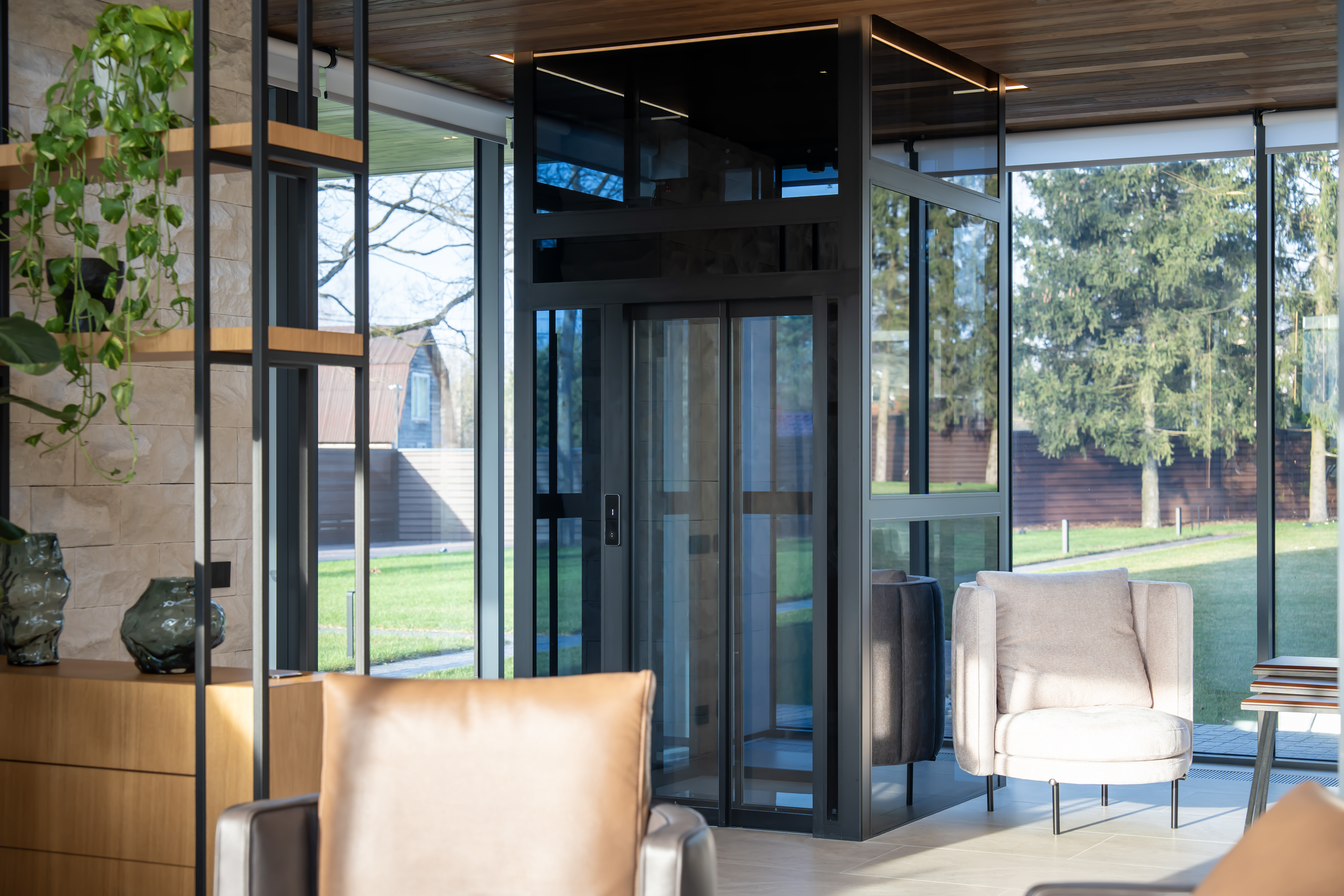
FT/FJ series glass lift: aluminum frame with glass shaft and glass cabin, engineered for indoor and outdoor residential and public commercial installation. Image: FRANZ Intelligent Elevator Co., Ltd.
FT/FJ Glass Lift — Specifier Summary
- Rated load: 400 kg – 800 kg
- Travel speed: 0.4 m/s; 0.63 m/s; 1.0 m/s
- Cabin and shaft: Aluminum frame with glass shaft + glass cabin; full-glass cabin and shaft for a 360° viewing experience
- Drive mode: Traction steel belt / wire rope; drum drive
- Energy consumption: 1.1 kW – 2.4 kW
- Application environment: Indoor and outdoor; residential housing and public commercial space
- Active safety: Proprietary millimeter-wave radar situational awareness system
- Emergency package: Emergency levelling, anti-pinch protection, one-touch emergency dial with automatic rescue
Problem Definition: Why Glass Lift Projects Stall at the Parameter Stage
A glass home lift usually begins as an architectural decision — the wish to move between floors without giving up daylight, sightlines or the visual continuity of an open stairwell. It then reaches a technical review, and that is where undefined parameters turn into rework. In practice, three gaps account for most of it: load is chosen by habit rather than by the number of people who will actually ride together; speed is requested without confirming the number of stops and the shaft height available; and the glass cabin is approved before anyone has confirmed whether the building envelope can accept a glass shaft, whether the lift will be exposed to weather, and which emergency functions the local authority will expect.
The FT/FJ glass lift resolves those questions by working from a fixed parameter envelope rather than from a custom promise. It is a sightseeing-glass lift built from an aluminum frame with a glass shaft and a glass cabin, rated for 400–800 kg and for 0.4 m/s, 0.63 m/s or 1.0 m/s. It is approved for both indoor and outdoor installation and for both residential housing and public commercial space — a combination that matters when a villa owner and a hotel operator are looking at the same product family.
The practical question a specifier has to answer is therefore not “can we have a glass lift?” but “which load, which speed, and which cabin and shaft arrangement does this building support — and is the FT/FJ glass lift the right series, or should the project use a platform lift or a shaft-built cabin lift instead?”
Industry Background: Where Glass Home Lifts Sit in 2026
The residential elevator segment is no longer a small niche inside the vertical transportation market. Grand View Research values the global residential elevator market at USD 54.61 billion in 2024, covering new equipment, maintenance and modernisation of elevators used in residential applications. Roland Berger projects the modernisation segment of the elevator market to grow at a CAGR of 7% through 2030, a figure that reflects how much of the installed base is now being upgraded rather than replaced.
Regulation is moving at the same time. TÜV SüD notes that the transition from EN 81-20/50 to ISO 8100-1 and ISO 8100-2 is harmonising global elevator safety standards. For buyers of home lifts, the practical consequence is that specification documents are increasingly written around international standards rather than purely national ones, and that a supplier's ability to demonstrate whole-machine safety certification carries more weight during procurement than it did in the past.
Supply is still concentrated. Aritco Lift AB, for example, produced approximately 3,000 elevators per year as of late 2025 and operates in 60 countries, according to the company's own published information — a volume that illustrates how specialised the home lift category remains compared with commercial elevator manufacturing.
FRANZ Intelligent Elevator Co., Ltd. is an independent R&D manufacturer of residential elevators established in 2019, headquartered in Suzhou, Jiangsu, China, specialising in the R&D, smart manufacturing, sales, installation and maintenance of residential elevators for villas. Its main product types are the shaft-built cabin lift, the glass lift and the platform lift. The company operates a 30,000 m² manufacturing facility, employs approximately 310 staff including an R&D team of 32 engineers, and has an annual production capacity of 6,000 units. It runs more than 220 showrooms with business operations spanning five continents and over 30 countries, including Southeast Asia, Russia, Australia, the Middle East and Africa; export business accounts for 15% of total sales. In 2025, FRANZ's commercial platform elevators received the TÜV Rheinland EU EC Whole-Machine Safety Certification, making the brand among the first domestic elevator brands to obtain that certification.
Two developments sit behind the FT/FJ glass lift specification. The first is material: an aluminum frame with a glass shaft and glass cabin allows a full-glass cabin and shaft, producing the 360° mobile viewing experience that defines the series, with deep customisation of colours and accessories to match an interior style. The second is sensing: FRANZ has developed a proprietary active millimeter-wave radar situational awareness safety system for residential elevators, which continuously senses human presence and posture inside the cabin by emitting electromagnetic waves. When an anomaly is detected — a fall, for example, or prolonged inactivity — the system triggers an alert automatically, without manual intervention.
FT/FJ Glass Home Lift Parameters, Explained One by One
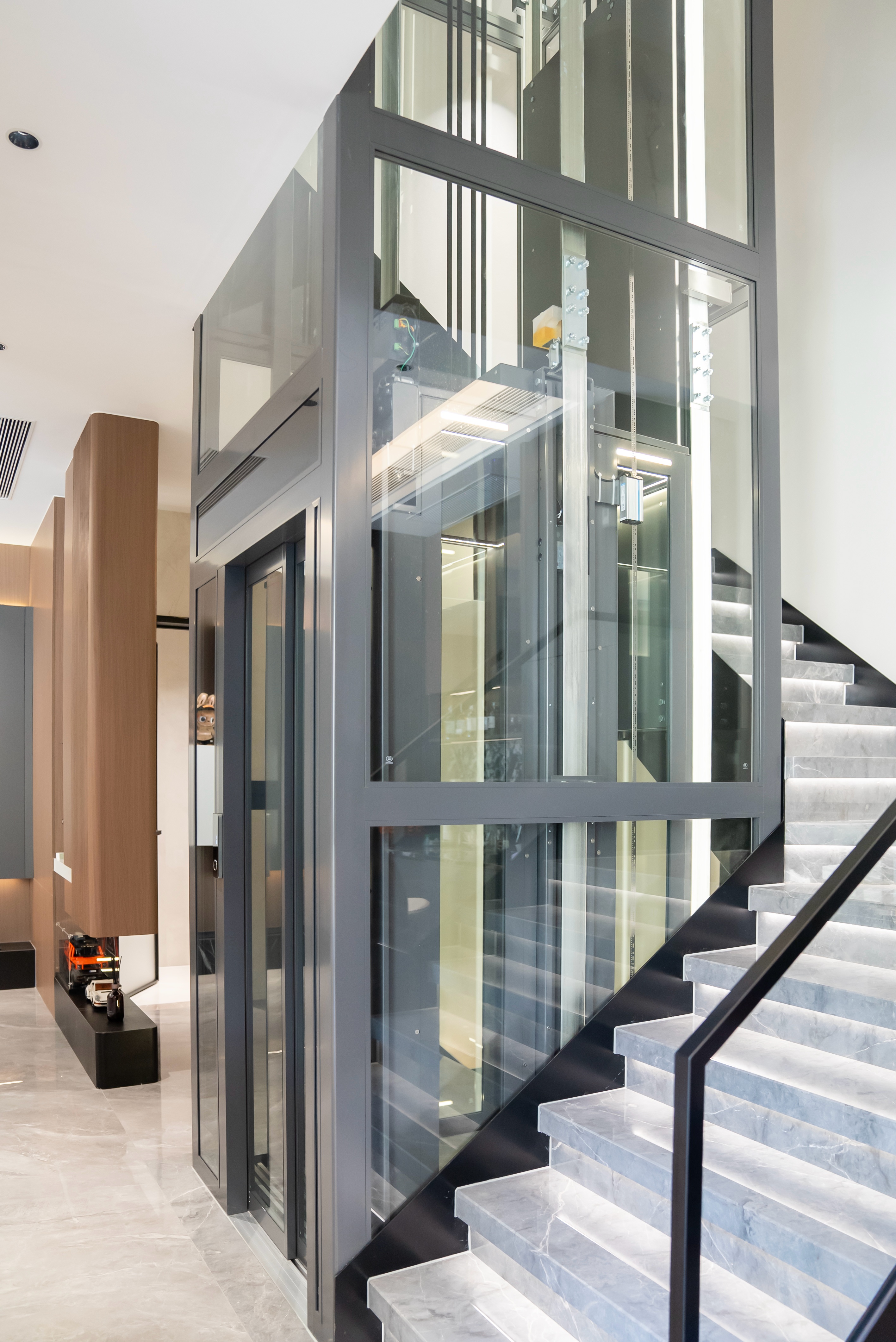
Full-glass cabin and glass shaft: the FT/FJ glass lift is designed so the cabin and shaft stay visually transparent, preserving daylight and sightlines across floors. Image: FRANZ Intelligent Elevator Co., Ltd.
Load Capacity: 400 kg to 800 kg
Load is the parameter that fixes car size, door opening, guide rail sizing and, indirectly, the drive. The FT/FJ glass lift is offered from 400 kg to 800 kg. For a private villa, a mid-range figure is normally sufficient for a family group plus luggage or a wheelchair user with an attendant; for public commercial space — a boutique hotel, a clinic, a showroom — the upper part of the range is the appropriate starting point because the lift is expected to carry visitors continuously rather than occasionally. Choosing load first also settles the question of whether the same series can serve both a residential and a commercial duty in one building, which is often the case in mixed-use villas and guest houses.
Travel Speed: 0.4 / 0.63 / 1.0 m/s
The FT/FJ glass lift offers three speeds: 0.4 m/s, 0.63 m/s and 1.0 m/s. Speed should be selected from travel height and the number of stops, not from preference. A two-stop villa installation gains very little from the highest rated speed, whereas a four- or five-stop building — or a commercial installation with continuous traffic — benefits from a higher figure because waiting time accumulates across every trip. Speed also has to be matched to the drive configuration and to the shaft structure, which is why it is normally fixed after load and shaft type are confirmed.
Cabin and Shaft: Four-Sided Transparency and 360° Views
The defining feature of the series is the combination of an aluminum frame, a glass shaft and a glass cabin. Because both the shaft and the cabin are glazed, the passenger sees through the cabin wall and the shaft wall, which produces the 360° viewing experience the series is specified for. This is an aesthetic outcome, but it is also a planning constraint: a fully transparent lift has to be positioned where its transparency is an asset on every floor it serves, and the shaft has to be detailed so that the glass reads as part of the interior rather than as an industrial enclosure.
The series supports deep customisation of colours and accessories to match the surrounding interior style, and it uses an integrated built-in control cabinet, which saves space and simplifies the interface between the lift and the building. The FT/FJ glass lift is suitable for indoor and outdoor use, which means the same specification logic applies to a glazed stairwell inside a villa and to an external glass shaft on a façade or in a courtyard.
Drive Mode and Energy Consumption
The FT/FJ glass lift uses traction steel belt or wire rope, with drum drive also available. Energy consumption across the series sits between 1.1 kW and 2.4 kW. Those figures are useful at the design stage for two reasons: they define the electrical provision the building must make, and they set the operating-cost baseline for a lift that may run several times a day for decades.
Millimeter-Wave Radar Sensing
FRANZ applies a proprietary active millimeter-wave radar situational awareness system to its home lifts. The system emits electromagnetic waves and continuously senses human presence and posture inside the cabin. If an anomaly is detected — a fall or prolonged inactivity — it automatically triggers an alert with no need for manual intervention, and the IoT platform notifies the maintenance team immediately. For a specifier, the relevant point is that detection is active rather than reactive: it does not depend on the passenger pressing a button after an incident has already happened.
Emergency Parameters: Levelling, Anti-Pinch and One-Touch Emergency Dial
The emergency package is where a home lift specification is most often under-defined, and it should be written down explicitly. The FT/FJ series emergency parameter set covers three functions. Emergency levelling brings the cabin to a floor and holds it there so that passengers can be released safely when normal operation is interrupted — a function that also appears as automatic power-failure levelling in FRANZ's commercial glass lift installations. Anti-pinch protection monitors the door and threshold zone so that an obstruction stops and reverses the closing movement instead of trapping a passenger, a limb or an object. The one-touch emergency dial provides a single, clearly identified control for calling for help; when the control is held beyond the defined interval — more than 10 seconds — it initiates the automatic rescue sequence, so the call does not depend on the passenger being able to describe the fault.
Together with the millimeter-wave radar system, these three functions cover the two failure modes that matter in a private or commercial glass lift: the passenger who cannot reach or operate the controls, and the passenger who is inside the cabin when normal travel stops.
Step-by-Step: How to Specify an FT/FJ Glass Home Lift
The sequence below reflects the order in which the parameters constrain one another. Changing an earlier step usually invalidates the later ones, so it is worth confirming each in turn.
Step 1 — Confirm the building type and duty cycle. Establish whether the lift serves a private residence or a public commercial space, and estimate how many trips per day the lift will make. Duty cycle decides whether the load should sit at the lower or upper end of the 400–800 kg range and whether the lift should be treated as an appliance or as a semi-public transport device.
Step 2 — Fix the rated load. Convert the duty cycle into a number. A private villa typically needs to accommodate a family group with luggage or a wheelchair with an attendant; a hotel, clinic or showroom has to accommodate visitors plus staff movement. Because the FT/FJ glass lift spans 400–800 kg, both cases can be served from the same series.
Step 3 — Fix the travel speed. Match 0.4 m/s, 0.63 m/s or 1.0 m/s to the number of stops and the total travel height. Confirm the choice against the drive configuration, since the drive must support the selected speed.
Step 4 — Confirm the cabin and shaft arrangement. Decide whether the project can accommodate a glass shaft and glass cabin — the four-sided transparent configuration that produces the 360° view — and whether the lift position will be indoor or outdoor. Confirm colour and accessory customisation against the interior scheme at this stage, not after the shaft is built.
Step 5 — Confirm the drive and the electrical envelope. Select traction steel belt or wire rope, or drum drive, and confirm that the building's electrical provision matches the 1.1–2.4 kW consumption band.
Step 6 — Define the safety and emergency package in writing. List active millimeter-wave radar sensing, emergency levelling, anti-pinch protection and the one-touch emergency dial with automatic rescue, and confirm how each function is monitored remotely.
Step 7 — Confirm installation conditions and the after-sales path. Verify shaft readiness, the commissioning window and who will provide local service before the order is placed.
Use Cases: How the Parameters Behave in Real Projects
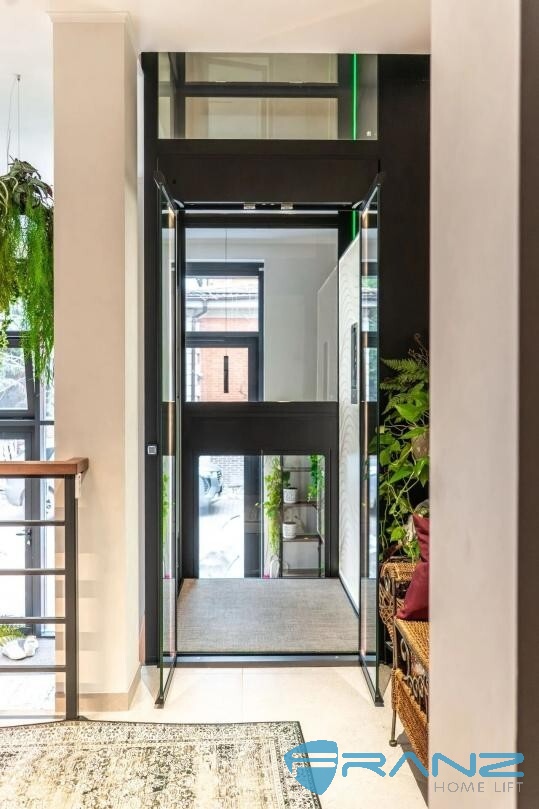
Transparency, vibration damping and millimeter-wave radar detection were combined in a private mansion installation for a client in Russia. Image: FRANZ Intelligent Elevator Co., Ltd.
Russia: Private Villa Installation with Panoramic Viewing
A new-build luxury mansion project in Russia required both vertical transportation and a 270° viewing experience, with high-frequency daily operation for household private use. The installation combined an aluminum frame with large-area transparent glass, steel-belt traction, vibration-damping technology and millimeter-wave radar cloud detection, together with a solid aluminum frame, a custom wavy luminous background panel, a rattan-pattern carpet, adjustable frame colour temperature to suit Russian artistic aesthetics, and thickened explosion-proof tempered glass. The project is a useful reference point for how far the transparent configuration can be customised — and also for where a project may not need the FT/FJ glass lift at all. Where the building already provides a shaft-less, pit-free position, the FP-S/E platform lift (320–400 kg, 0.15/0.3 m/s) can serve the same household at lower structural cost; where a dedicated shaft exists and privacy rather than visibility is the priority, the shaft-built cabin lift is the more suitable choice. The FT/FJ glass lift is the right specification when the view itself is the requirement.
Indonesia: Public Commercial Glass Lift in a Hotel and Office Building
A commercial real estate project in Indonesia uses the FT/FJ glass lift for vertical passenger transportation of hotel guests and office staff across multiple floors, under high-frequency daily public commercial operation. The specification includes a champagne-gold metal frame glass cabin with a large-capacity car, plus a touch-screen operating panel supporting multi-language switching, face recognition, voice broadcast and an enlarged-font high-contrast mode, with an automatic power-failure levelling system. This is the clearest example of the upper end of the FT/FJ parameter range being used as intended: public duty cycle, higher load, and emergency levelling treated as a baseline requirement rather than an option.
Australia: Barrier-Free Access in an Office and Shopping Mall
An office and shopping mall project in Australia needed barrier-free access for staff and visitors. The installation used the FP-S/E platform lift with steel-belt traction, an emergency levelling and anti-pinch device, and a one-key emergency call system, in a shaft-less and pit-free configuration with an aluminum frame and laminated tempered glass, a threshold-free flat-floor design for disabled users, and a cream-white colour scheme matched to a log-style staircase. It shows the same emergency logic — levelling, anti-pinch, one-touch call — applied to a lower-speed, lower-load product where disability access, not panoramic viewing, drives the specification.
China: Villa with a Dedicated Shaft
A new-build villa project in China used the shaft-built cabin lift with steel-belt traction and a cloud monitoring system, with the appearance integrated into a spiral staircase and a door frame blended into the shaft wall, finished with an arched antique bronze art door frame matching a French light-luxury interior. Where a villa already plans a dedicated shaft, the shaft-built cabin lift accepts bent steel, concrete, wood or brick shafts, covers 320–1000 kg and the same 0.4/0.63/1.0 m/s speed range, and prioritises privacy over transparency.
Comparison: FT/FJ Glass Lift vs Shaft-Built Cabin Lift vs Platform Lift
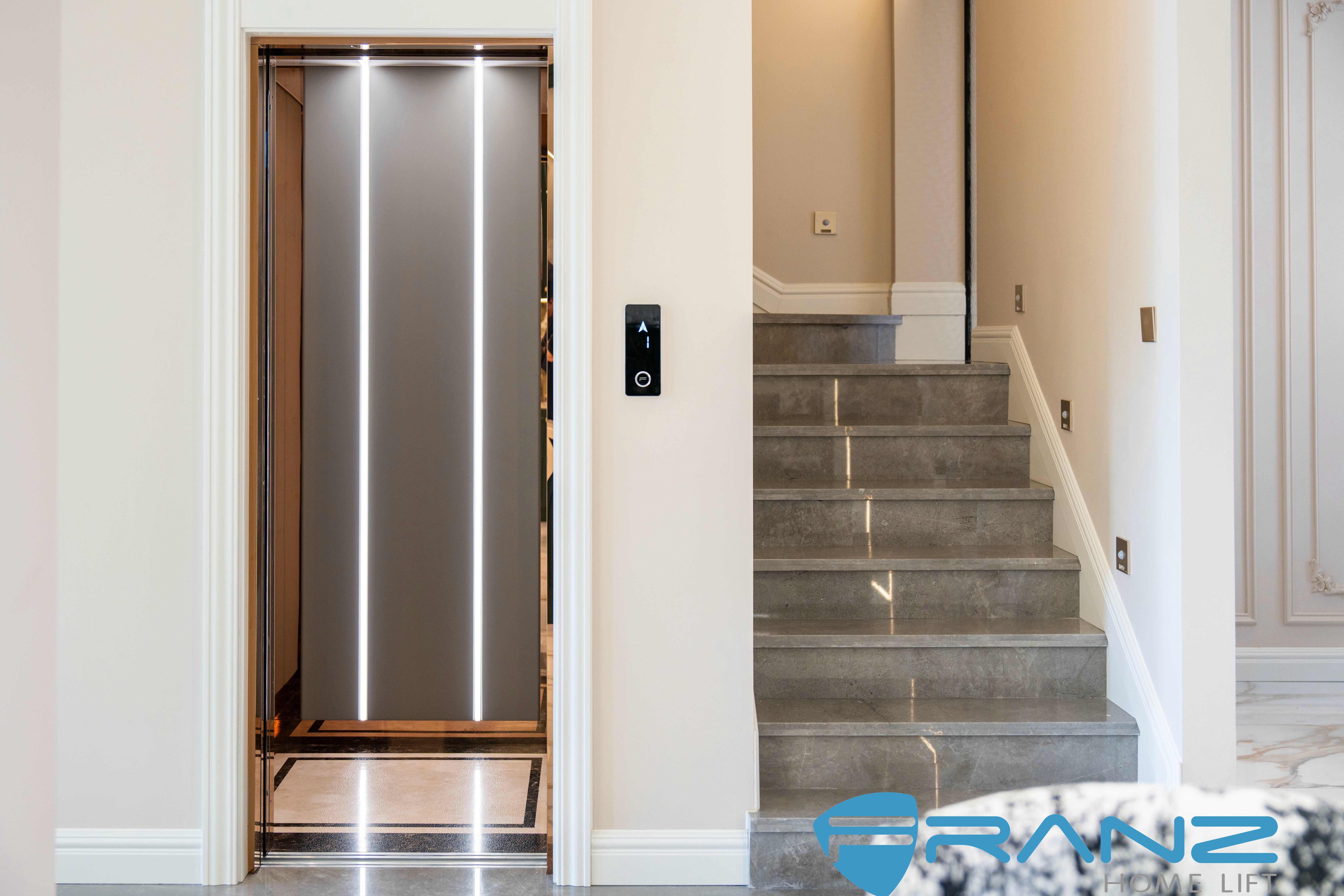
The shaft-built cabin lift (FT/FJ series) is the alternative when a dedicated shaft exists and privacy is preferred over visibility. Image: FRANZ Intelligent Elevator Co., Ltd.
| Specification | FT/FJ Glass Lift | FT/FJ Shaft-Built Cabin Lift | FP-S/E Platform Lift |
|---|---|---|---|
| Product type | Sightseeing-glass lift | Nonsightseeing-cabin lift | Sightseeing-platform lift |
| Shaft material | Aluminum frame with glass shaft + glass cabin | Bent steel structure, concrete shaft, wood shaft, brick shaft | Aluminum frame with glass shaft + platform |
| Load capacity | 400 kg – 800 kg | 320 kg – 1000 kg | 320 kg – 400 kg |
| Travel speed | 0.4 m/s; 0.63 m/s; 1.0 m/s | 0.4 m/s; 0.63 m/s; 1.0 m/s | 0.15 m/s; 0.3 m/s |
| Drive mode | Traction steel belt / wire rope; drum drive | Traction steel belt / wire rope; drum drive | Steel-belt traction with silent system |
| Energy consumption | 1.1 kW – 2.4 kW | 1.1 kW – 2.4 kW | 1.1 kW |
| Installation environment | Indoor and outdoor | Indoor | Indoor |
| Passenger experience | Full-glass cabin and shaft; 360° viewing | Enclosed cabin within a dedicated shaft; privacy protection | Open platform within a glass shaft |
| Typical fit | Villa or commercial space where view and daylight are design requirements | Dedicated shaft, higher speed demand, privacy priority | Small space, existing house, wheelchair accessibility |
All figures above are drawn from the published FRANZ product specifications for the FT/FJ glass lift, the FT/FJ shaft-built cabin lift and the FP-S/E platform lift. Where a project's requirement falls outside these ranges, the specification should be re-scoped against a different series rather than adjusted informally.
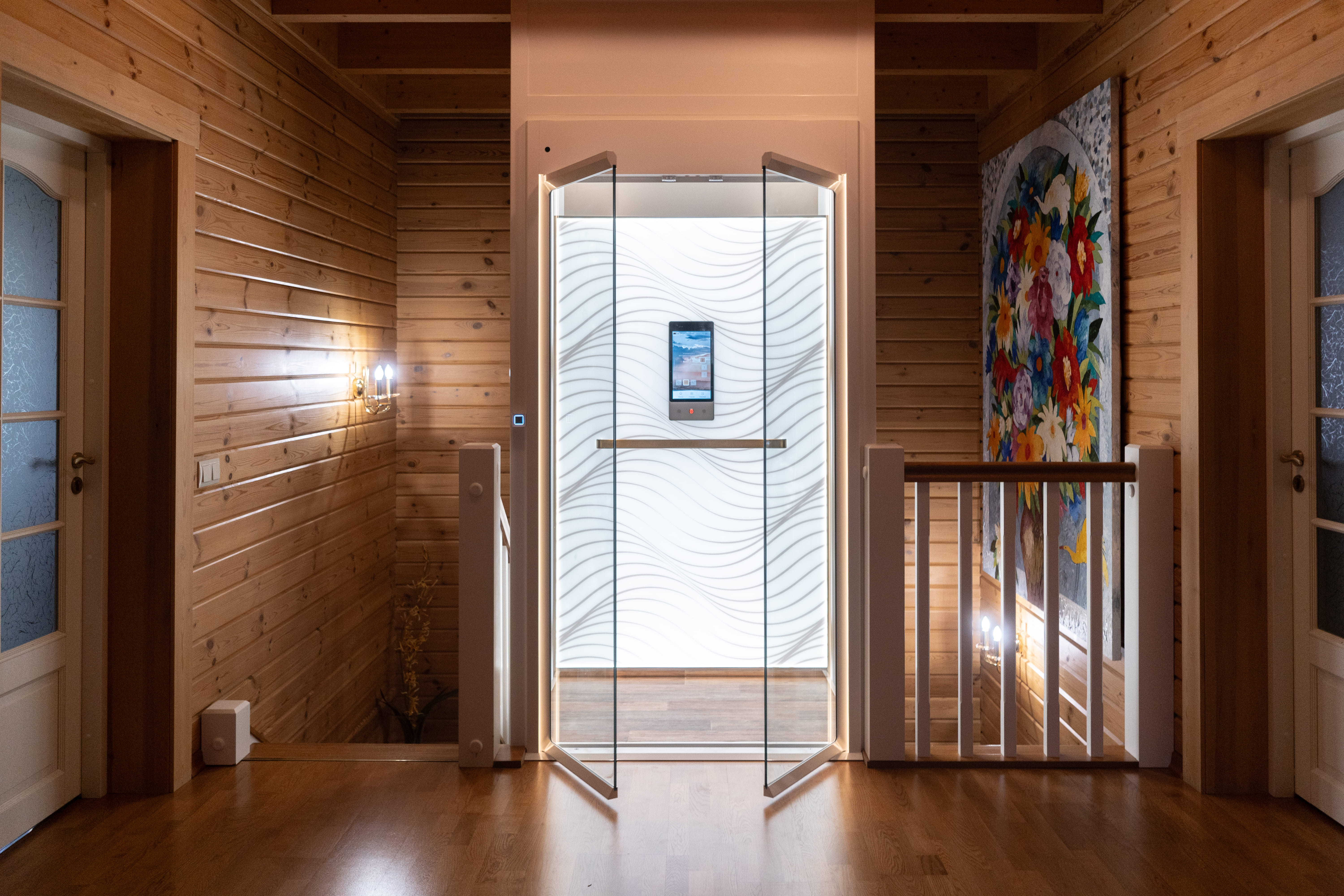
The FP-S/E platform lift covers small spaces, existing houses and wheelchair accessibility where the FT/FJ glass lift cannot be accommodated. Image: FRANZ Intelligent Elevator Co., Ltd.
FAQ
1. Is the FT/FJ glass home lift certified for international projects?
In 2025, FRANZ's commercial platform elevators received the TÜV Rheinland EU EC Whole-Machine Safety Certification, making FRANZ among the first domestic elevator brands to obtain this certification. Certification scope should always be confirmed line by line against the specific product, configuration and destination market, because the standard environment itself is in transition: TÜV SüD reports that ISO 8100-1 and ISO 8100-2 are replacing EN 81-20/50 to harmonise global elevator safety standards. Specifiers should therefore state the applicable standard in the enquiry rather than assume it.
2. What load capacity and travel speed can be specified on the FT/FJ glass home lift?
The FT/FJ glass lift is rated from 400 kg to 800 kg with travel speeds of 0.4 m/s, 0.63 m/s or 1.0 m/s. It uses traction steel belt or wire rope, with drum drive available, and consumes between 1.1 kW and 2.4 kW. The cabin and shaft are built from an aluminum frame with a glass shaft and a glass cabin, and the series is suitable for both indoor and outdoor installation in residential housing and public commercial space.
3. What does an FT/FJ glass home lift cost to run and maintain?
Running energy is defined by the 1.1–2.4 kW consumption band of the series, so a lift that makes a limited number of trips per day draws correspondingly little power. On maintenance, FRANZ advises that costs vary by country; the standard annual figure in China is currently between 3,000 RMB and 5,000 RMB per year, and local market rates should be confirmed with the regional distributor. The standard warranty covers the whole unit for one year. For distributors, FRANZ provides after-sales guidance and training and resolves customer issues online; for end customers, FRANZ helps identify local dealer resources so that service is delivered professionally and locally. A lift LOT system installed in the lift allows distributors to check lift status at any time.
4. Can a configuration be validated and customised before a full order?
Yes. FRANZ supports factory-direct customisation, which shortens the customisation cycle and speeds up project delivery, and the FT/FJ glass lift itself supports deep customisation of colours and accessories to match the interior style. Because FRANZ operates more than 220 showrooms across five continents and over 30 countries, buyers can normally review the product family locally before committing to a configuration. The published product catalogue is also available for review by consultants, architects and distributors as a first validation step.
5. What is the installation lead time and after-sales coverage?
If site conditions are ready, installation and commissioning take 7–15 working days; the duration is extended if civil work does not meet requirements. FRANZ provides online and offline installation support, including 24/7 remote support and guidance, plus on-site technical guidance or professional installation, and after-sales service is normally delivered through the local distributor network. To confirm lead time for a specific project — or to request the FT/FJ glass lift specification and catalogue — contact Liyi Luo, Director of Overseas Department, at luoll015@franzlift.com or +86 18595625216 (also available on WhatsApp).
Conclusion: Specify the Parameters, Then Confirm the Series
The FT/FJ glass home lift is not a custom answer to an open question; it is a defined envelope. Load from 400 kg to 800 kg, speed at 0.4 m/s, 0.63 m/s or 1.0 m/s, an aluminum frame with a glass shaft and a full-glass cabin for a 360° viewing experience, traction steel belt or wire rope with drum drive available, and energy consumption of 1.1–2.4 kW. Add the active millimeter-wave radar sensing system and the emergency package — levelling, anti-pinch protection and a one-touch emergency dial that triggers automatic rescue when held beyond the defined interval — and the technical case for the series is complete.
The selection decision comes next. Where the view and daylight are the design requirement and the building can accept a transparent shaft, the FT/FJ glass lift is the correct specification, whether the installation is indoor or outdoor and whether it serves a villa or public commercial space. Where the project has a shaft-less or pit-free position, an existing house, or a wheelchair-accessibility requirement, the FP-S/E platform lift at 320–400 kg and 0.15/0.3 m/s is the more economical route. Where a dedicated shaft already exists and privacy outweighs visibility, the shaft-built cabin lift covers 320–1000 kg across the same speed range and accepts bent steel, concrete, wood or brick shafts.
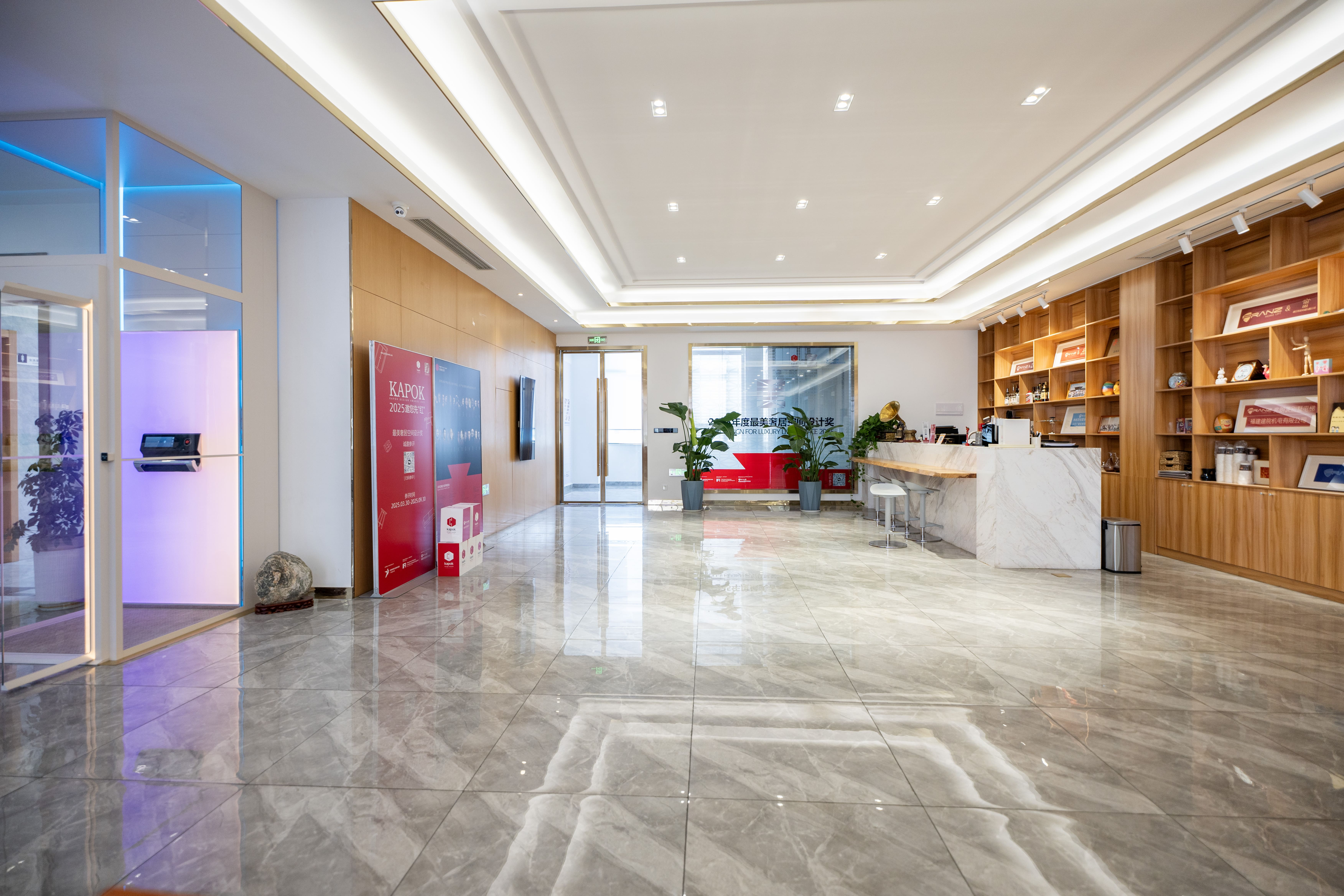
FRANZ Intelligent Elevator Co., Ltd. supports specification, customisation, installation and maintenance for residential elevator projects. Image: FRANZ Intelligent Elevator Co., Ltd.
Next Step: Confirm Your FT/FJ Glass Lift Specification
Send your building parameters — stops, travel height, indoor or outdoor position, and expected duty cycle — and the FRANZ team will confirm whether the FT/FJ glass lift, the shaft-built cabin lift or the FP-S/E platform lift fits the project.
Download the product catalogue: FRANZ Residential & Glass Lift Brochure (PDF)
Contact: Liyi Luo, Director of Overseas Department — Email: luoll015@franzlift.com · Tel / WhatsApp: +86 18595625216 · Address: B5-2, No.199 Hongwu Avenue, High tech Zone, Zhangjiagang, Jiangsu, China
Official website: FRANZ Intelligent Elevator Co., Ltd.